
Power Cage With Cable Crossover Review: One Machine for a Singapore HDB Home Gym
A power cage with dual independent cable crossover at S$1,658.64, reviewed honestly against its product gallery for the Singapore home-gym buyer with one room and a barbell.
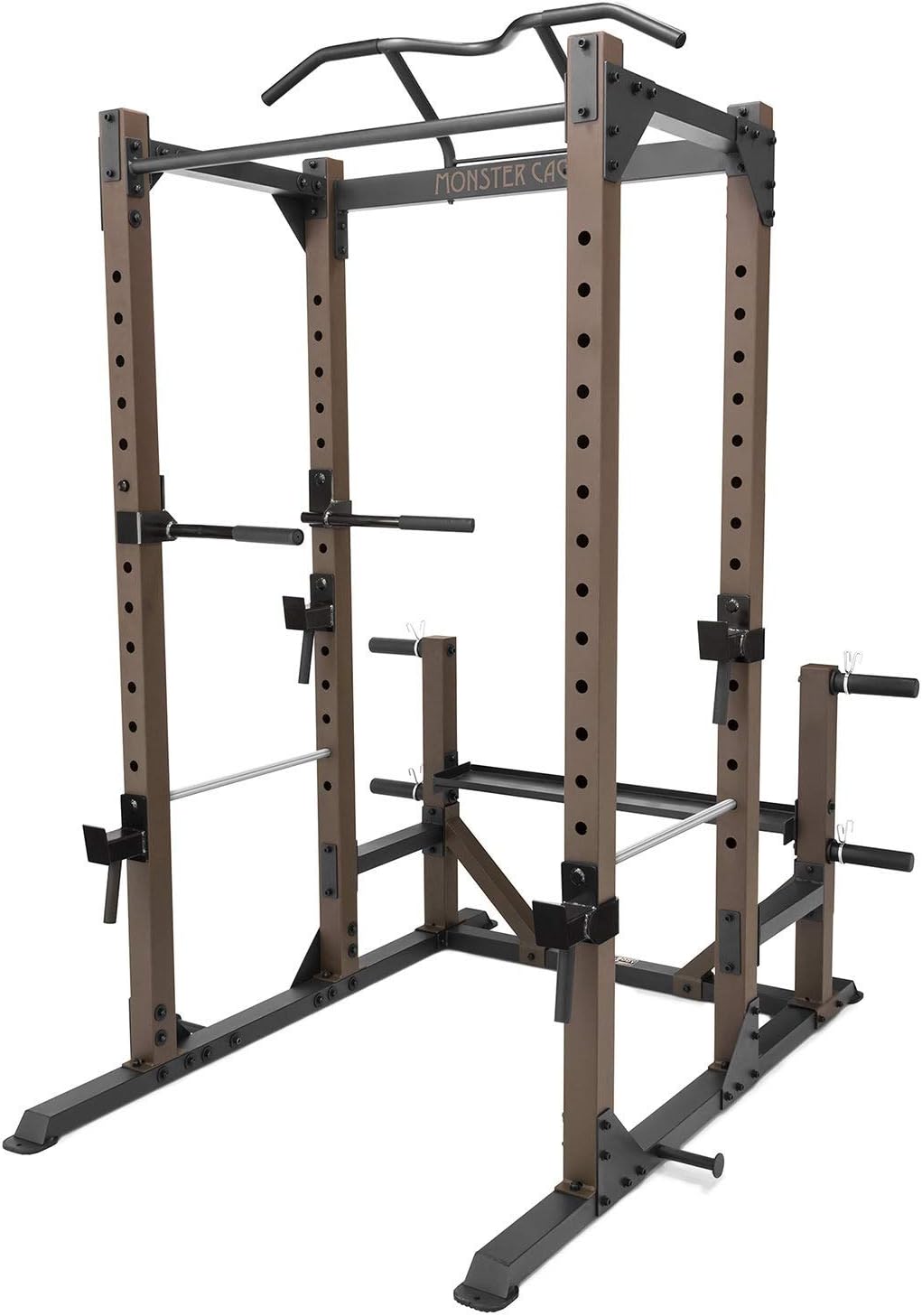
The gyms.sg desk gets one version of the same email every week from readers who outgrew an adjustable-dumbbell setup. They want a squat rack. They also want cable rows, lat pulldowns, tricep pushdowns. They do not want to spend S$8,000 on a real commercial functional trainer. The listing that keeps surfacing as the sub-S$2,000 answer is a red-and-black power cage with a dual cable crossover bolted onto the uprights, currently at S$1,658.64 on Amazon's Singapore storefront. This is a review of that unit, written honestly: no one on this desk has owned it. What follows is a careful read of owner reviews, a cross-check of the product gallery against the narrative copy, and a verdict framed for the buyer who wants one machine in an HDB study room to do the work of three.
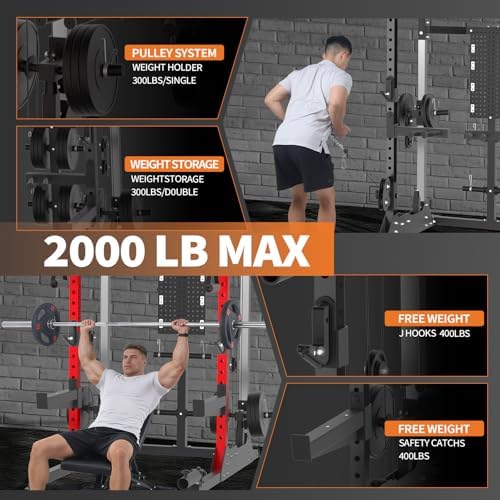
A note on skepticism. Power-cage listings in this price bracket are notorious for spec drift between the marketing description and the gallery photos. This unit is no exception. The narrative copy implies a 2,000 lb maximum frame rating, but the J-hooks themselves are rated at 400 lbs, the safety catches at 400 lbs, the pulley weight holder at 300 lbs per side. Those are the numbers the buyer will actually load. The gallery wins, and the article uses the gallery numbers throughout.
Delivery, unboxing, and the floor decision you make once
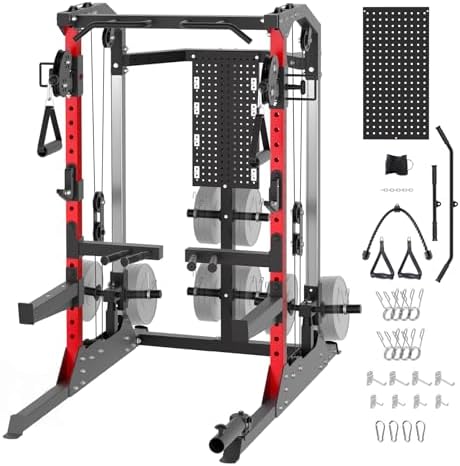
This unit does not arrive 90 percent pre-assembled the way a home elliptical does. It ships in two or three long flat-pack boxes weighing 70 to 90 kg total, with uprights, crossmembers, cable housings, pulleys, and accessory clips packed flat. Owner reports cluster the assembly time at three to five hours solo, two to three hours with a second person. Several reviewers describe the printed manual as adequate rather than excellent. Set aside an afternoon, lay every bolt out on a towel by size before starting, and the build is straightforward.
The footprint matters more than the assembly. The cage occupies roughly 165 cm by 130 cm at the base, with another 50 to 60 cm of clearance on the cable-stack side so the user can stand outside the cage to row and press. Add the bench, the loaded barbell, and walk-around space, and the realistic floor budget is about 3.5 m by 2.5 m. That fits in a one-bedroom condo study or a converted HDB bedroom. The cage stands roughly 215 cm to the top of the uprights, and a user pulling down on the cable handle wants another 30 cm above that. A standard 2.6 m HDB ceiling works. A lowered false ceiling under 2.4 m compromises the high-cable movements.
One pre-purchase decision the buyer cannot undo: flooring. On tile or concrete with rubber gym tiles underneath, the unit feels rock-solid. On parquet without mats, owners report a slight wobble during dynamic pulls because the rubber feet cannot grip a polished surface. Budget S$120 to S$200 for four to six interlocking 1 cm rubber tiles before the cage arrives.
The frame: where the rated numbers and the printed numbers diverge
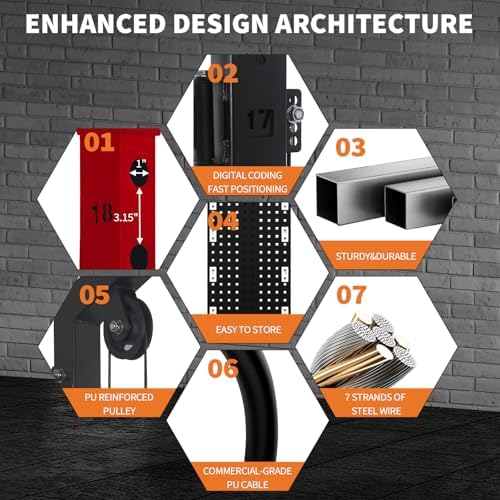
The uprights are square-section steel tube, matte black with red contrast on the front crossmembers. Owner photos put the tube wall at roughly 2 mm to 3 mm, consistent with the price tier. The hole spacing is 1 inch on a 3.15-inch face, granular enough to dial in a competition bench height or a rack-pull pin height without forcing the next user to compromise.
Here is the spec drift. The listing prints "2000 LB MAX" as the headline frame rating: a cumulative maximum across every attachment point combined, the kind of number that exists to be impressive on a hero image. The numbers that matter when loading plates are smaller and specific. The J-hooks holding the barbell during squats and bench press are rated at 400 lbs, roughly 180 kg. The safety catches are also rated at 400 lbs. The pulley weight holder is 300 lbs per side.
For most home lifters this is enough. A 180 kg back-squat is past the point where 95 percent of recreational lifters will ever train. The buyer who needs to worry about that ceiling is the powerlifter mid-meet-prep with a 200 kg-plus competition squat, and that buyer should be looking at a S$3,000-plus rack with 3-inch tube uprights, not this cage. For the buyer at S$1,658.64, the 400 lb J-hook rating is honest. The 2,000 lb headline is marketing.
The dual cable crossover: the feature that earns this listing its slot
Strip out the cable crossover and this is an ordinary mid-tier power cage. The crossover is what makes the listing genuinely interesting at S$1,658.64. Two independent plate-loaded weight holders run on a 1:1 pulley ratio, meaning every 10 kg loaded is 10 kg of resistance at the handle, not the 2:1 reduction some entry-level functional trainers use to fake heavier-feeling resistance. The 1:1 ratio is what serious lifters want for cable work because the resistance curve matches the load curve, no halving of perceived weight at the handle.
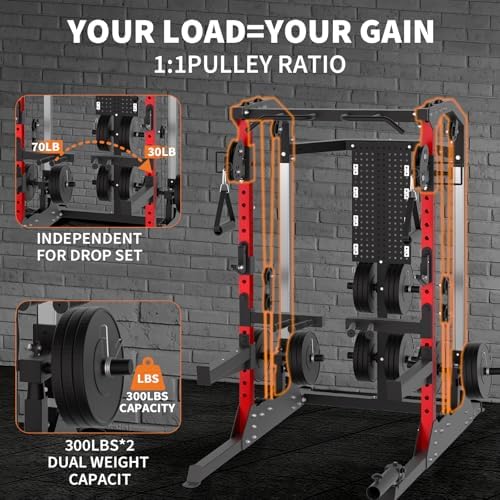
"Independent" in the gallery is doing real work too. The two pulley arms can be loaded differently and used simultaneously by two users without one pulling against the other. In a household where one partner trains heavier, that matters: 30 lbs on the left for a pulldown, 50 lbs on the right for a row, both running at once. The crossover handles cable rows, lat pulldowns, tricep pushdowns, face pulls, cable curls, low-cable hip work, and the standing chest fly the "crossover" name refers to. Half a functional trainer's exercise menu folded into a power-rack footprint.
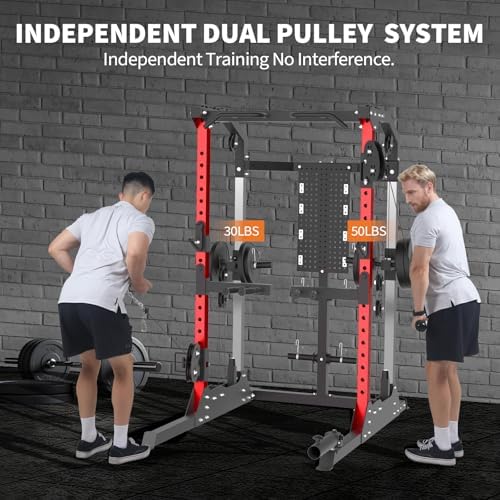
The pulleys are PU-reinforced, the cable jacket is commercial-grade PU, the cable core is a 7-strand steel wire braid. That stack is the same construction every credible mid-tier functional trainer uses. It matters because the part of a cable machine that fails first is almost never the frame, it is the cable jacket cracking or the pulley wheel warping. PU jackets last five to seven years under daily home use. Replacement cables are widely available and a 20-minute job.
The compound-lift use case: bench, squat, rack-pull, overhead press
The reason most buyers look at a power cage rather than a squat stand is the safety catches. This unit's safeties run the full inside width of the cage, attach via 1-inch-hole spacing, and at 400 lbs will catch any missed bench-press attempt a home lifter can realistically generate. That changes training: a home lifter without a spotter can push close to a true one-rep max because the safeties bail the bar out. With a half-rack or a pair of squat stands, the same lifter trains within a 70 to 85 percent margin and never finds out their real top-end strength.
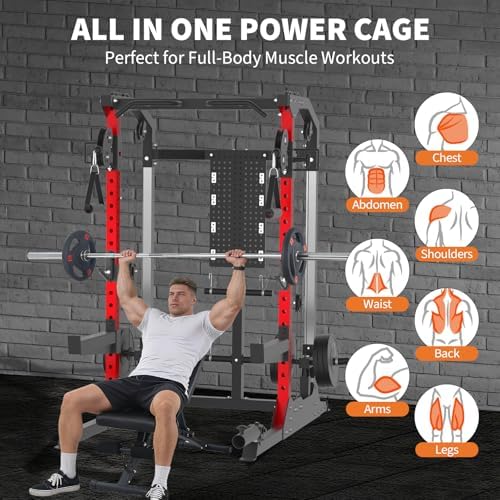
The cage interior is roughly 105 cm wide, enough for a standard 7-foot Olympic bar (220 cm) to sit on the J-hooks with about 55 cm of sleeve protruding each side for plate loading. Plates load from outside the cage without the user climbing in and out, which matters when stripping 20 kg between fatiguing sets.
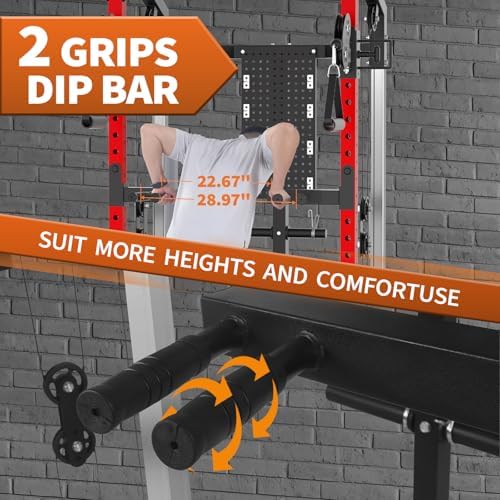
The dip bar attachment gives two grip widths at 22.67 inches and 28.97 inches: tighter for triceps emphasis, wider for chest. Small spec, real impact. Most fixed-width dip stations fit one body type and frustrate everyone else in the household.
What the unit does not include: a barbell, plates, or a bench. Budget S$300 to S$500 for a 20 kg Olympic bar rated for at least 300 kg, S$500 to S$800 for 100 to 150 kg of plates, and S$200 to S$400 for an adjustable flat-incline-decline bench. Total home setup: roughly S$2,700 to S$3,500 against a commercial Smith-plus-functional-trainer setup at S$8,000-plus. The math holds.
"Skip the basic squat stand and just get this.
Storage and the small detail most buyers miss
The pegboard panel earns a paragraph. Most cages at this price are bare frames and the buyer is left to figure out where to hang attachments. This listing includes a steel pegboard that mounts to the rear upright, with cutouts sized for the J-hooks, safety catches, single-handle attachments, tricep rope, and dip handles. Everything in the box has a home. That sounds trivial. It is load-bearing for whether the unit stays usable at month six: cages where attachments live in a heap on the floor get used less, because every workout starts with a five-minute search for the right handle.
Claimed specs vs gallery-verified, one consolidated table
When the marketing copy and the gallery photos disagree, the article goes with the gallery. Here is the consolidated table the buyer should screenshot before committing:
| Spec | Listing narrative | Product gallery | Verified |
|---|---|---|---|
| Frame max load | 2,000 lbs (headline) | 2,000 lbs (overlay) | 2,000 lbs cumulative across attachment points |
| J-hooks rating | Not specified in narrative | 400 lbs (callout) | 400 lbs (about 180 kg) |
| Safety catches rating | Not specified | 400 lbs (callout) | 400 lbs |
| Pulley weight holder | Implied heavy | 300 lbs single, 600 lbs combined | 300 lbs per side |
| Pulley ratio | "Your load equals your gain" | 1:1 overlay | 1:1 |
| Upright hole spacing | Granular adjustment | 1 inch on a 3.15-inch face | 1-inch spacing, 3.15-inch tube |
| Cable construction | Commercial cable | PU jacket, 7-strand steel core | PU over 7-strand steel |
| Pulley wheel | Reinforced | PU-reinforced | PU-reinforced |
| Dip bar grip widths | Two grips | 22.67" and 28.97" | 22.67" / 28.97" |
| In-box accessories | Full kit | Pegboard, dip handles, two single handles, tricep rope, J-hooks, carabiners | All confirmed in hero shot |
The takeaway: nothing in the gallery is exaggerated in a way that catches a buyer out. The "2,000 lb" headline is a cumulative figure; the more conservative per-attachment numbers (400 lbs at the J-hooks, 300 lbs per pulley) are printed honestly in the same gallery. A buyer who reads the gallery carefully knows what they are getting.
Where the unit falls short, named honestly
The cable crossover handles are plate-loaded, not pin-selected. Changing the load mid-superset takes 15 to 30 seconds of stripping and reloading plates against the two seconds it takes to move a pin on a Life Fitness selectorised stack. For drop sets and quick-load cable circuits this is the unit's biggest practical limitation. The workaround is to load both pulleys for the heaviest movement first, then strip down for lighter assistance work at the end of the session.
The pull-up bar at the top is functional, single-grip, not wide enough for the genuinely tall lifter who wants a 32-inch-plus grip. Owner reports describe it as adequate for standard width, not for the wide-grip lat-focused variation a 1.85 m lifter might prefer. A buyer wanting premium pull-up geometry should look at a higher-tier cage with a multi-grip rainbow bar.
There is no built-in landmine attachment. Adding one is a S$40 to S$80 aftermarket purchase and a five-minute install, but it is not in the box. If landmine work is core to your program (T-bar rows, landmine presses, rotational core work), factor it in.
Finally, the unit is not bolted to the floor. On rubber mats over a hard floor it is rock-solid for the rated loads. For a buyer training kipping or plyometric pull-ups, a floor-bolted commercial cage is a better choice. For everyone else, the free-standing format means the cage can be relocated when the household moves, which matters in a Singapore rental market where two-year leases are the norm.
Wrap-up: the verdict for the Singapore home-gym buyer
This is the most coherent compound-plus-cable home setup the desk has read about in the sub-S$2,000 bracket. It does three jobs honestly: power cage with full safety catches and J-hooks, dual independent cable crossover at a 1:1 ratio, and an integrated pegboard storage system for every accessory in the box. The frame is rated more conservatively than the headline suggests, but the per-attachment numbers are still past where a recreational lifter will train. The cable system uses the same construction stack as machines costing twice as much. The accessory kit is complete in a category where most listings force the buyer to spend another S$300 piecing together attachments.
The verdict
Buy if you are a recreational-to-intermediate lifter training in an HDB study or condo spare room, want one machine to handle bench, squat, rack-pull, overhead press, plus a full cable accessory menu, and your top-end squat is comfortably under 180 kg. Wait if you do not yet own a barbell, plates, and an adjustable bench, because the realistic total spend is S$2,700 to S$3,500 once you add those. Skip if you are training competition-level powerlifting, need pin-selected cable stacks for rapid drop-set work, or do not have at least 3.5 m by 2.5 m of floor space with rubber matting under a 2.6 m ceiling.
What would change the verdict. A revision with pin-selected cable stacks at the same price would flip the recommendation upward for cable-focused programs. A price drop below S$1,400 would make the case strong enough that most readers in the floor-space-and-budget range should buy without hesitating. A jump above S$2,000 would put it in competition with mid-tier dedicated power racks with 3-inch tube uprights, weakening the value proposition.
If the verified spec table fits your constraints, the listing sits at S$1,658.64 on as of mid-May 2026. The desk will revisit if the price moves more than 10 percent or the seller ships a hardware revision under the same listing.
For anyone still upstream of the single-product decision, the longer rack-buying piece for Singapore home lifters covers the framework: full cage vs half-rack vs squat stand, footprint, ceiling, anchor decisions, and the upgrade path most first-time buyers regret skipping. This page reviews one unit. That page teaches the category.
Related Guides
Power Rack vs Smith Machine for Home Gym Singapore
Power rack vs Smith machine for Singapore home gyms , safety, footprint in HDB-sized rooms, exercise variety,
HDB Home Gym Build: The Five-Decision Walkthrough
Five decisions govern an HDB home gym build. Make them in this order , rack architecture, rack height, plate m
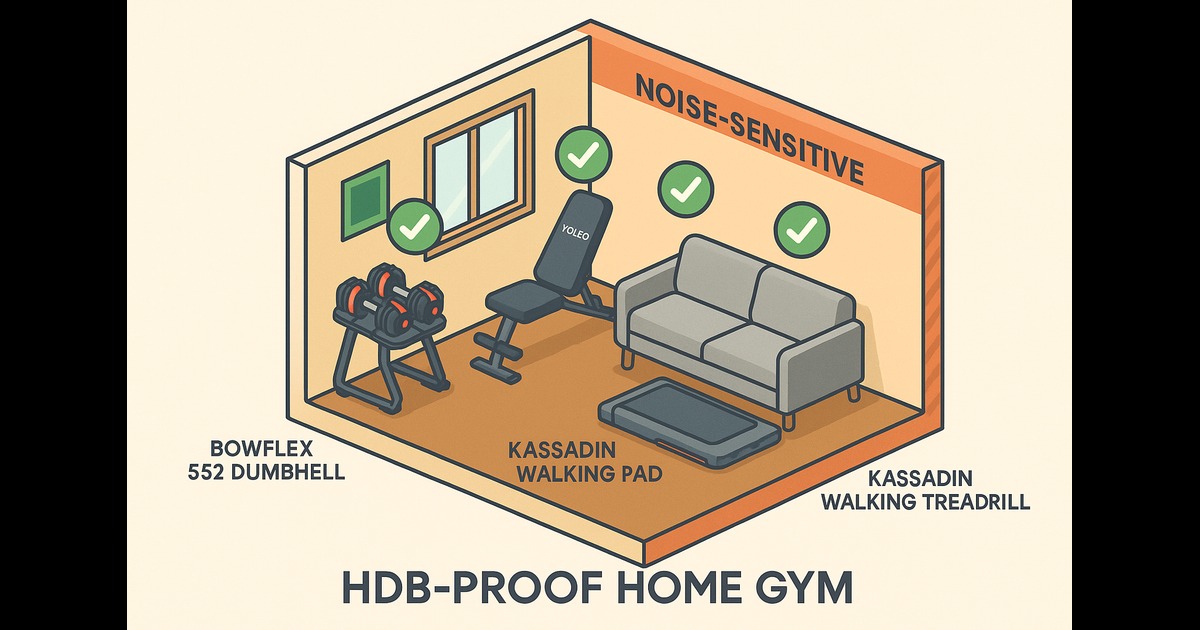
HDB Home Gym Guide Singapore: Space, Noise & Floor Protection
HDB home gym guide for Singapore , what fits in 99sqm without floor cracks, noise complaints, or wasted money.
Home Gym Barbell Set Singapore
Home gym barbell set guide for Singapore , Olympic vs standard, which set actually survives HDB humidity, and