
HDB Home Gym Planning: Space, Storage and Noise
Your equipment list should follow the exercises and space you will use. Plan the room, storage, delivery and first purchase before adding a larger machine.
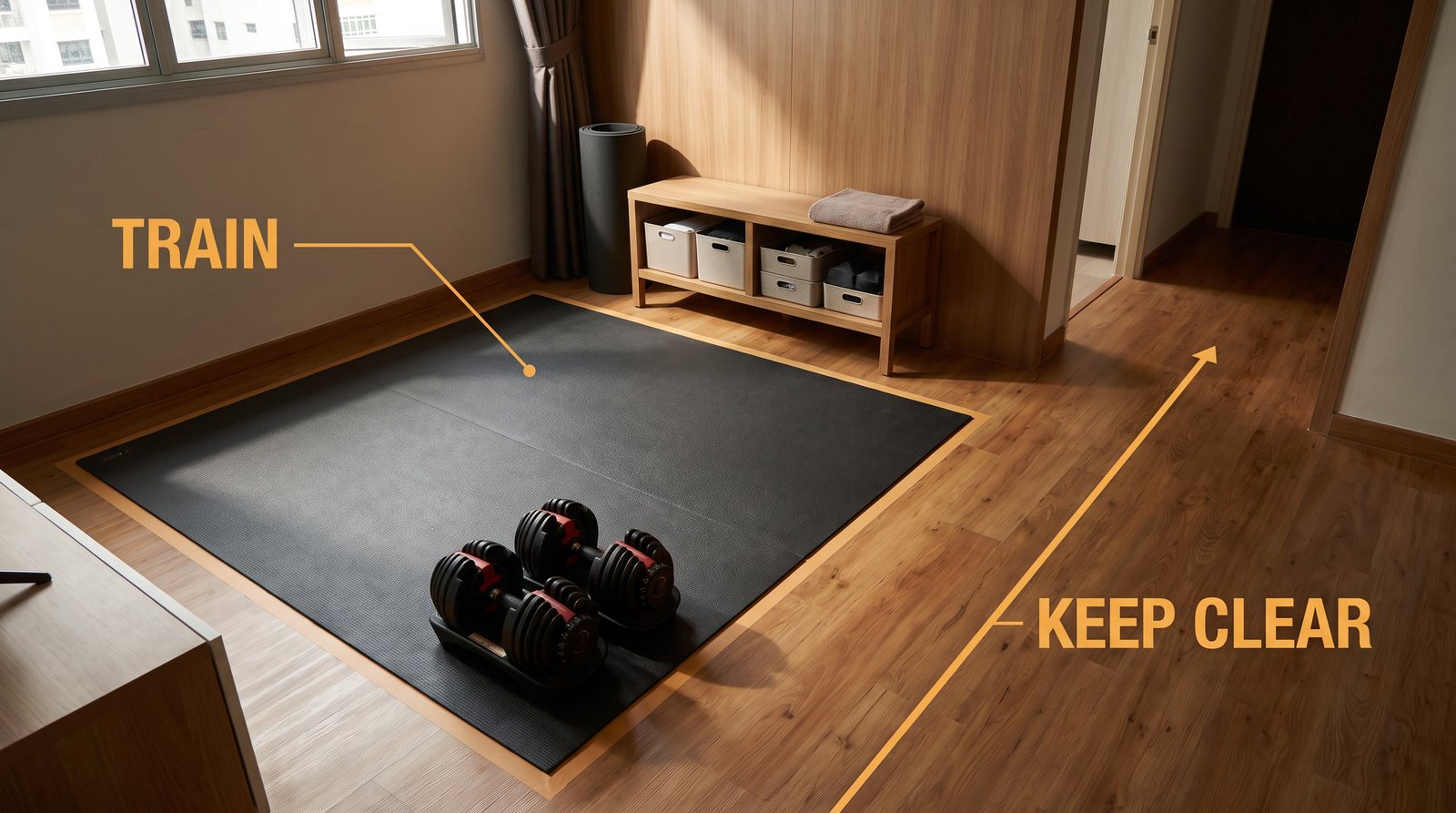
Plan an HDB home gym around the exercises you will do and the space they need while you move. Start with the smallest useful setup, then check storage, delivery, noise and the suitability of the installation before adding heavier equipment.
There is no useful universal answer such as “every flat needs 15 m²” or “every floor allows 200 kg”. A yoga mat, a bench with dumbbells and a loaded rack create different demands; the room dimensions alone do not settle them.
What will you actually train at home?
Write down a normal week's exercises before choosing equipment. For each one, record what you already own, what it needs and whether you can do an acceptable alternative with less equipment. The home gym planner gives you a place to put that list next to your room measurements.
| Your intended use | First decision | What to avoid buying too early |
|---|---|---|
| Floor exercises and mobility | Check the clear movement area and a suitable surface | A large machine that removes the floor space you need |
| Dumbbell training | List the loads and increments your programme uses, plus safe storage | A maximum-weight claim without knowing weight per hand |
| Bench exercises | Check required angles, combined load and access around the bench | A bench for exercises you do not plan to do |
| Walking or running indoors | Separate operating clearance from folded storage | A walking-only machine if running is your actual goal |
| Barbell training | Check rack, bar, bench and safety-system compatibility together | A rack chosen only because its frame fits against the wall |
If you still need to discover what training you enjoy, use the gym directory to find a place to try the relevant equipment. Confirm trial terms directly with the operator. Buying a complete home setup before you know which exercises you will keep is an expensive way to answer that question.
How much usable space do you have?
Measure the area after allowing for doors, wardrobes and the paths other people use. Tape out each proposed machine's operating footprint and the clearance in its manual. Keep its folded or stored footprint as a separate drawing.
Then rehearse the ordinary routine without weights: bring the equipment out, move into position, get up and put it away. Check arm and leg movement, access to handles and room to place equipment down. Stop if you would need to improvise around furniture or block a doorway.
Do not borrow a minimum clearance from a different product. A rack needs access to its safeties and bar sleeves; an adjustable bench changes position; a cardio machine has its own mounting and dismounting requirements. Check ceiling fittings and the highest intended movement as well as floor area.
What belongs in the first purchase?
Buy the item that removes a real obstacle in your chosen routine. If you already have enough resistance but spend each session moving furniture, solve storage before buying heavier weights. If your programme needs a bench, compare a bench rather than unrelated recovery accessories.
For a compact bench example, the manufacturer's CORENGTH Folding Bench 500 support page, reference 8616804, states a 220 kg limit including the user and weights, and a 20 cm folded height. Those figures demonstrate two separate checks: usable load and storage. They do not establish Singapore stock, that it fits your exercises, or that the rest of your setup is suitable.
The workout bench guide explains the measurements to compare. For cardio, the folding treadmill guide distinguishes belt size, full machine size and delivery access. Use those details to narrow the purchase; avoid assuming that “compact” describes the entire training area.
How should you think about floor load and anchoring?
List the machine, stored plates or dumbbells, users and intended movements when discussing the installation. A total weight on a product page is not a structural assessment of the floor beneath it.
Ask the relevant building authority or a qualified professional when suitability is uncertain, especially for a concentrated heavy installation or work that changes the flat. A rubber mat does not establish structural capacity. For drilling or alterations, check HDB's renovation guidance and the actual proposed work before proceeding.
Use only the anchoring arrangement allowed by the equipment manufacturer and appropriate for the surface. Do not assume that any door frame can carry a suspension trainer or that a freestanding rack can safely accept every attachment.
Can you use it without disturbing the household?
Consider the exercise, the time and the way equipment is put down. Avoid dropping weights. Choose controlled movements and equipment use that suit the setting, and discuss problems with neighbours if they arise rather than assuming a mat settles them.
HDB's neighbourliness guidance advises avoiding noisy activities, particularly from 10:30pm to 7am. Those hours are not a guarantee that any noise is acceptable at other times. If your only available training slot conflicts with the household or neighbours, keep that activity at a suitable gym.
Storage matters here too. Weights left in a walkway or a folded machine that is not secured according to its instructions make the room harder to use. Decide who can access the equipment and where cables, adjustment pins and other loose parts will be kept.
What should go into the budget?
Use a complete first-stage budget: equipment, delivery, assembly, suitable floor protection, necessary storage and any known installation or service costs. Keep optional upgrades on a separate list.
Ask for packaged dimensions and a delivery quote covering your actual access route. A machine that fits in the room might not fit through the lift or turn into its doorway. Confirm who is responsible for unpacking, assembly and removing packaging.
Avoid making the purchase affordable only by assuming a future resale price. Used equipment needs a model and condition check, a recall check where relevant, and confirmation of support. Record what is known and leave the rest unresolved; “commercial grade” is not a service contract.
How do you know when to add more equipment?
Use the first setup for a short review period you choose, then note what repeatedly limits your planned sessions. Record setup time, exercises you could not do, the loads you needed and whether storage worked for everyone using the room.
Add something when it solves a repeated limitation. If the barrier is lack of time or a room that must be cleared before every session, another machine may make that problem worse. A home setup and occasional gym visits can also be a workable combination; compare the actual activities and total cost rather than treating either route as a complete replacement by default.
What should you measure before buying anything?
Record the clear room dimensions, ceiling obstructions, door swing, storage space and delivery route. Then add the exact equipment's operating and packaged dimensions, manual clearance and permitted use. Keep unknown figures on your question list instead of filling them with a typical value.
Use the home gym planner to put the room drawing, first purchase and later upgrades on one plan. Your next purchase should fit that plan as well as your budget.