
Niceday Elliptical Review: Honest Read for a Singapore HDB
Niceday elliptical buying guide for Singapore: check the exact model, stride, dimensions, delivery and servicing before deciding whether it fits your home.
OnWhey is our own supplement brand.
The gyms.sg desk already published a general buying guide for home ellipticals in Singapore. For a Niceday purchase, identify the exact model and variant before comparing the listed dimensions, stride and resistance system. No one on this desk owns the Niceday CT11. What follows is an honest aggregation: every credible owner review on Amazon, every Niceday write-up the home-gym review sites have published, the manufacturer's own listing, and the seven product photos the listing actually ships to a buyer.
A note on skepticism, because it matters. Niceday's narrative copy and Niceday's product photos do not say the same thing on stride length and weight capacity. The narrative copy claims an 18-inch stride and (in places) a 500 lb user weight. The product gallery says 16 inches and 400 lbs. This review goes with the gallery, because that is what the buyer actually sees when the box arrives in a Singapore lift lobby. The earlier draft of this piece took the wrong numbers. This one corrects them.
The price as of mid-May 2026 is S$1,697.08. That puts the CT11 in the awkward middle of the home-elliptical market: more than the S$400 unit a buyer regrets in three weeks, less than the S$3,500 commercial-tier machine with a touchscreen and a 22-inch stride. The real question is whether it earns its place against everything in that range, including the temptation to spend the same money on a home treadmill, or a year of gym memberships in Singapore instead.
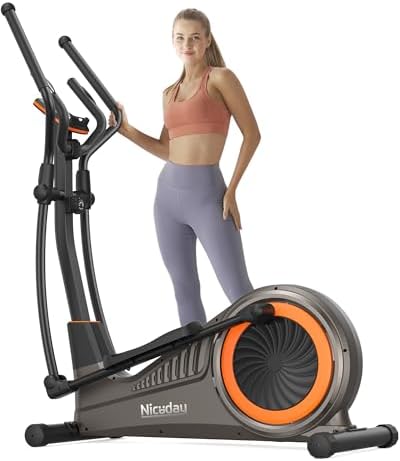
Delivery, unboxing, and the 20-minute build
Owners consistently report that the CT11 ships about 90 percent pre-assembled. The flywheel housing and the main frame arrive mated. The buyer attaches the handlebars, the pedal arms, the front stabilizer, and the console. Across Amazon reviews and independent posts, the build time clusters in a 20 to 30 minute window with a single person and the tools that ship in the box. Niceday's own overlay on the assembly photo (visible below) claims "20 mins effortless assembly." Owner reports treat that as roughly honest, not marketing-only.
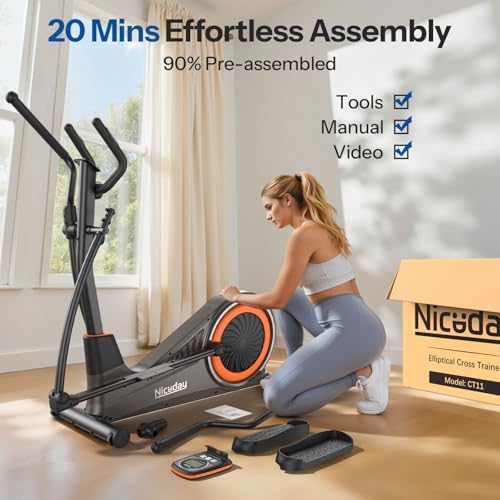
The caveat: the printed manual is sparse, and the small hardware bags are labelled functionally rather than friendly. Several owners describe sorting bolts by length on the floor and figuring out which goes where by physical fit. Not a dealbreaker. A warning to set aside an actual hour and not try this with a Saturday-morning hangover. The assembled unit weighs roughly 105 lb. Heavy enough to feel stable underfoot once it is up. Heavy enough that getting it into a fourth-floor walk-up or a narrow lift is a two-person job, not a polite one-person carry. The transport wheels at the front of the frame work cleanly on hard floor, which matters in an HDB where the elliptical will live against a wall during the week and roll forward into the living room for the workout itself.
The hardware, where the price actually goes
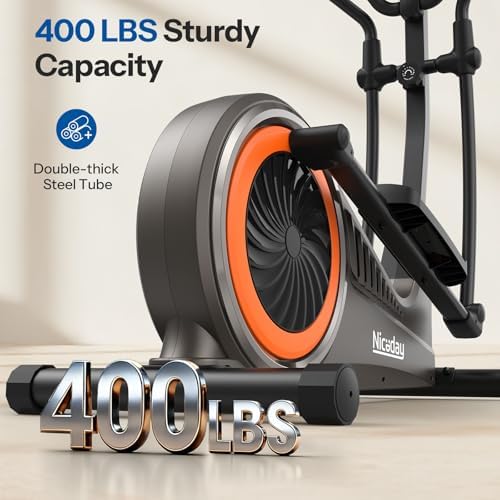
The frame is welded steel, painted black, with the resistance housing forward of the user and the flywheel sitting low. Niceday markets it as "double-thick steel tube," and owners who have lived with it for six months and beyond consistently note the frame does not flex under load even at the 400 lb rated weight capacity. The welds are visually clean rather than ground smooth. That is appropriate to the price tier: this is not a commercial unit pretending to be one, it is an honest-gauge home-tier frame.
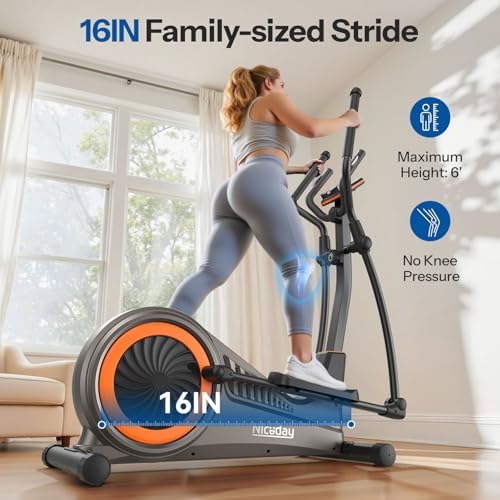
The stride length is 16 inches. The brand markets the unit as comfortable for users up to about 6 feet, and the gallery image below carries that "Max Height 6'" overlay alongside the "16IN Family-sized Stride" claim. Independent reviewers split on this. A 16-inch stride is honest for a user up to about 5'10". For a 1.83 m / 6 foot user, expect the motion to feel closer to a brisk walk than a glide. For anyone taller, the stride will read as cramped and the elliptical motion will start feeling like marching in place rather than running. Niceday's spec sheet says one thing in the narrative copy and another in the gallery; this review goes with what the product photos show because that is what owners actually see when the box arrives.
The flywheel is rated at 16 lbs. The category baseline for sub-S$2,000 home ellipticals is roughly 6 to 15 lb of flywheel mass. A heavier flywheel produces a smoother stride at any given resistance level because it carries more rotational inertia through the dead spot at the top of the pedal arc. Owners describing the CT11's motion as "smooth at most levels" line up with that. The category-typical complaint, that the motion feels jerky at low resistance because the flywheel is too light to keep itself spinning, does not appear in the CT11 reports.
"It's not an elliptical trainer. It's a circular trainer. The motion is so smooth you can read on it."
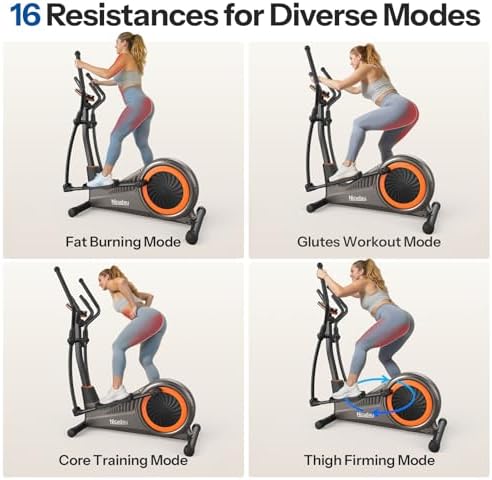
Resistance is magnetic, 16 levels. The mechanism is the same as every home elliptical in this tier: a magnet assembly slides closer to or further from the flywheel rim, increasing eddy-current drag. No motor, no plug, no cord. The console runs on two AA cells (replace every six months under daily use), the user's legs run everything else. Owners report the resistance steps are usable across the range. Levels 13 through 16 get described as light by fitter users training intervals. Read that as: if you are a competitive cyclist looking for serious glycolytic stress on a Tuesday evening, you may top out the machine before you top out yourself. For everyone else, the top end is enough.
The console and the app, kept deliberately simple
The console is a basic LCD that displays six metrics: time, speed, distance, calories, odometer, and pulse. It has a Bluetooth chip for a free companion app pairing. It does not have a backlight, a touchscreen, built-in workout programs, instructor video, or any connection to Zwift, Peloton, or any third-party platform beyond what the basic app exposes. The pulse only reads when the user holds the fixed front grips, not the moving outer handles. That limitation is universal in this price tier.
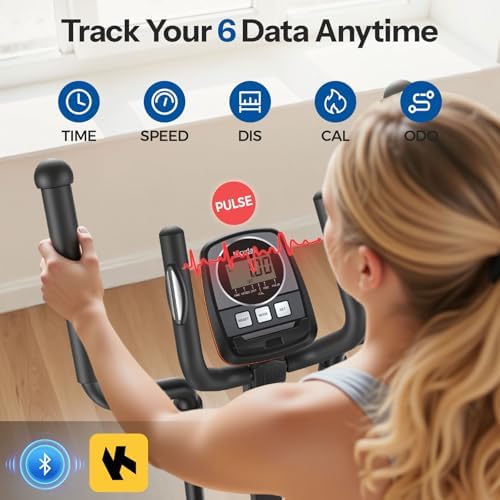
Read this honestly. The CT11 is not built to entertain you. If you need gamification, leaderboard, instructor video, or structured intervals beyond what you build yourself in a separate app on a separate screen, this is not the machine. The buyer who is happiest with the CT11 is the buyer who already has a Netflix subscription, an iPad on a music stand, and a workout plan that does not require the elliptical's console to coach them through it.
Using it: stride feel, noise floor, sweat
The noise claim is the standout marketing line. Niceday describes the magnetic resistance system as quieter than 20 dB, with the marketing copy adding the phrase "quieter than breathing." Owner reports back that this is roughly accurate in the way these things go: the elliptical itself is genuinely quiet, the loudest sound during a session is the user's own footfall on the pedals and the squeak of clothing against the handlebars. For a Singapore HDB user who works out at 6 a.m. while a partner is still asleep on the other side of a thin wall, that is the relevant data point.
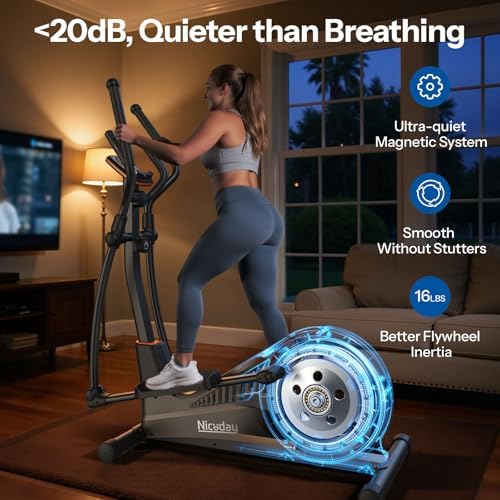
The stride feel, for a user under 1.80 m, is the closest the price bracket gets to a true gliding motion. The 16-inch path plus the 16 lb flywheel together produce something owners describe as smooth and continuous rather than jerky. The pedals are oversized, ridged plastic, with a slight inward tilt. Owners report no foot numbness over 30 to 45 minute sessions, which is a real complaint on cheaper machines where the pedals are flat, hard, and small enough that the foot bears most of its weight on a single ridge after twenty minutes. Knee comfort gets called out specifically in Niceday's overlays. Owners with prior knee complaints from running consistently report being able to put in 40-minute sessions on the CT11 without next-day soreness.
Niceday's gallery breaks the 16 resistance levels into four "modes" with names like Fat Burning, Glutes, Core, and Thigh Firming. Be honest about what this is. There are no separate workout programs. The "modes" are resistance presets and posture suggestions, not actual app-driven workouts. If you bought it expecting the console to walk you through a glute-focused session, you will be disappointed. If you bought it expecting a magnetic elliptical that you can program yourself across 16 honest resistance levels, the hardware delivers.
Sweat handling is the second real-world concern in a tropical climate. The pedals and frame shed water cleanly with a microfibre after a session. The console is in a slight recess at handlebar level and stays mostly dry. The owners who report long-term durability problems are the ones who let sweat pool on the console housing for weeks; that is a maintenance issue, not a build issue.
Post-use: storage, cleaning, what owners report after six months
The CT11 does not fold. It rolls. The footprint stays roughly 55 inches by 22 inches whether the unit is in use or not. For an HDB user, the realistic storage answer is to park it against the longest wall of the living room and roll it out for sessions. Cleaning is a wipe-down: microfibre across the frame, a slightly damp cloth on the pedals, never spray cleaner directly on the console. Owners six months in report no rust, no flywheel grinding, no resistance drift. The pulse sensors are the first thing to fail by owner reports, but pulse on grip sensors is a flaky measurement on any home elliptical and is not a reason to choose or reject this unit.
For the technical buyer: claimed specs vs the product gallery
Niceday's listing is internally inconsistent in two places. The model name on the box is CT11, but the narrative description across the broader Niceday SKU range cites different stride and capacity figures than the product photos for this specific unit. This is what the gallery says, which is what the buyer sees:
| Spec | Listing claim (narrative) | Product gallery | Verified |
|---|---|---|---|
| Model | Niceday Elliptical | CT11 (printed on box) | CT11 |
| Stride length | 18 in (in some copy) | 16 in (overlay) | 16 in |
| Max user weight | 500 lbs (in some copy) | 400 lbs (overlay) | 400 lbs (about 180 kg) |
| Flywheel | 16 lb | 16 lb | 16 lb |
| Resistance | Magnetic, 16 levels | Magnetic, 16 levels | Magnetic, 16 levels |
| Console metrics | Time, speed, distance, calories, odometer, pulse | Six metrics + Bluetooth | 6 metrics, Bluetooth pairing |
| Noise floor | Less than 20 dB ("quieter than breathing") | Less than 20 dB overlay | Genuinely quiet (owner-confirmed) |
| Assembly | 20 minutes, 90% pre-assembled | "20 mins effortless assembly" | 20 to 30 min single-person |
Two takeaways for the technical buyer. First, when narrative copy and product photos diverge, the photos are what you can hold the seller to under consumer-protection law in Singapore. Second, the verified numbers are still strong for the price tier. A 16 lb flywheel, 16 magnetic resistance levels, a 180 kg user weight rating, and a genuinely sub-20 dB noise floor at S$1,697.08 is a fair package, even adjusted for the more conservative stride.
Wrap-up: the verdict, framed for a Singapore HDB buyer
The CT11 is the most coherent home elliptical the desk has read about in this price bracket for a Singapore-specific use case. The HDB context rewards three things: a quiet machine, a stable frame at user weights up to about 100 kg, and a build process that fits inside a single Sunday afternoon. The CT11 meets all three. It loses points only where it explicitly chose to lose them: no programs, no instructor video, no smart-platform integration, no 18-inch stride for genuinely tall users.
The verdict
Buy if you are under 1.80 m, want a low-impact cardio machine that runs near-silent in an HDB, already have your own workout content on a phone or iPad, and value an honest 16 lb flywheel over a glossy console. Wait if you are 1.83 m or taller and have not stood next to a 16-inch stride machine; go test one in person before committing. Skip if you need built-in programs, instructor video, Zwift or Peloton integration, or a stride that does not narrow at the top of the pedal arc for a tall user.
What would change the verdict. A revised CT12 with an honest 18-inch stride at the same price would flip the recommendation upward for tall users. A pricing drop below S$1,400 would make the case strong enough that even buyers with mild reservations about the console-light experience should consider it. A pricing jump above S$2,000 would weaken the value proposition relative to the next tier up.
If the verified spec table fits your constraints, the listing is at the current Niceday CT11 product page (Amazon.sg listing unavailable on 22 September 2026), S$1,697.08 as of mid-May 2026. The desk will revisit this page if the price moves more than 10 percent in either direction, or if Niceday quietly ships a hardware revision under the same model number.
For anyone still upstream of the single-product decision, the longer elliptical buying guide for Singapore HDB owners covers the framework: stride, flywheel, resistance, ceiling height, footprint, console expectations. This page reviews one unit; that page teaches the category.
Related Guides
Ab Roller Wheel Review Singapore
Honest review of the ab roller wheel for Singapore home workouts , which models actually survive HDB humidity,
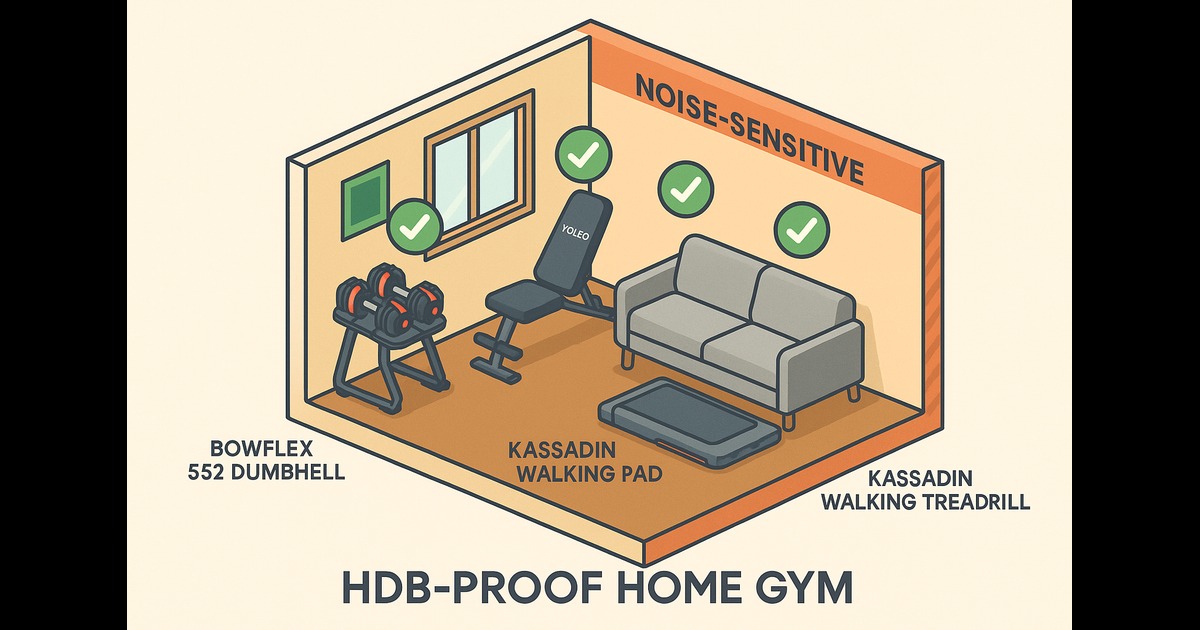
HDB Home Gym Guide Singapore: Space, Noise & Floor Protection
HDB home gym guide for Singapore , what fits in 99sqm without floor cracks, noise complaints, or wasted money.
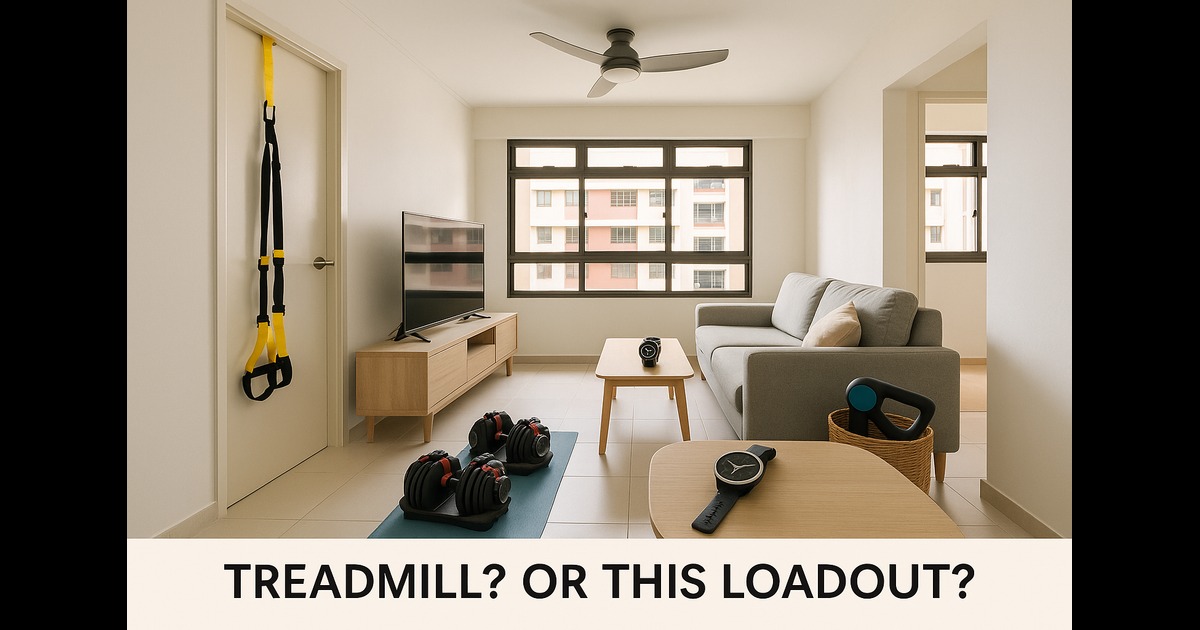
Best Foldable Treadmills for HDB Singapore
Foldable treadmills for HDB flats , folded footprint reality vs marketing claims, motor noise through concrete
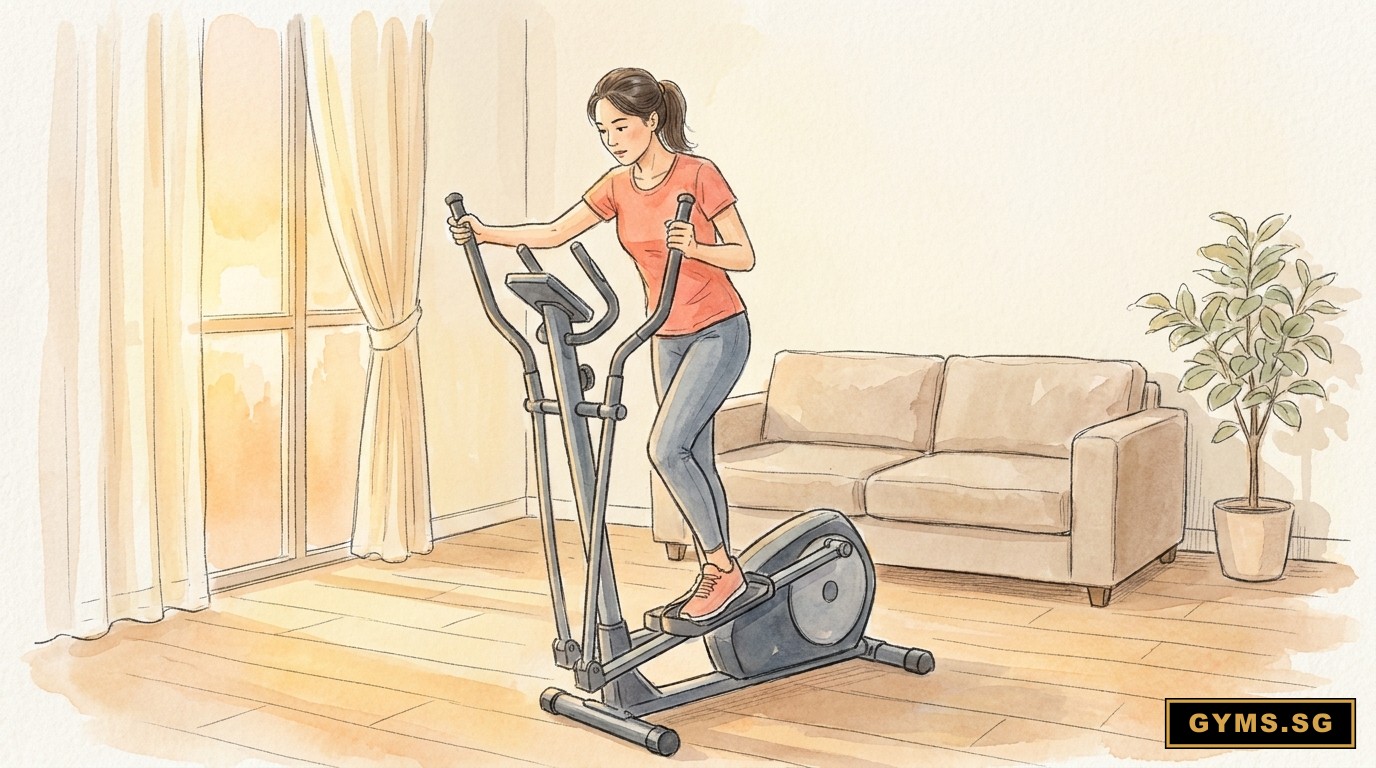
Picking a Home Elliptical in Singapore (2026): One Pick, Plus What to Skip
Compare elliptical stride, available floor space, ceiling clearance and servicing before deciding whether ownership fits your routine.