
HDB Home Gym Build: The Five-Decision Walkthrough
Five decisions govern an HDB home gym build. Make them in this order — rack architecture, rack height, plate mix, flooring, accessory integration — and the build pays back over five years instead of being resold on Carousell.
There is a right order to plan a Singapore HDB home gym, and there is the order most people use. The wrong order costs roughly S$1,200 to S$1,600 in resale losses and re-buys inside the first year. The right order costs the same total but ends with a room you can actually train in for five years.
This is a planning walkthrough, not a shopping list. It is for the reader who has not bought anything yet, or who has bought only a bench and is wondering what comes next. By the end of it you will know which decision to make first, which to make last, and where the cheap-looking shortcuts hide their real cost. The gyms.sg desk has watched enough Carousell listings of "upgrading, must go" S$280 racks to map the pattern.
Before any of this: is a home gym the right answer at all?
A full HDB build, done right, lands around S$4,000 to S$4,500 minimum. ActiveSG charges S$15 a month for unlimited access to commercial racks at Tampines Hub, Clementi, Sengkang, and Bishan. Twenty-two years of ActiveSG costs less than the home gym entry ticket.
Building at home only pays back if three things are true at the same time:
- You train 12+ sessions a month and have done so consistently for at least 18 months.
- One of the following holds: no ActiveSG gym within a 20 minute commute, your training hours sit outside public-gym opening times, or you train with equipment public gyms do not stock.
- Your housing horizon is at least three years. A full cage weighs around 90 kg assembled and the bolt holes loosen with each disassembly cycle.
If two or more of those are false, stop here and use the Singapore gym directory to find a public option. The rest of this article assumes all three are true.
The build-order framework: five decisions, in this order
Decisions cascade. Decision 1 constrains 2 and 3. Decision 2 constrains 4. Decision 5 only works if 1 was done right. Most failed builds are not bad gear, they are good gear bought in the wrong order.
| Order | Decision | Cost to get wrong | Time to feel the mistake |
|---|---|---|---|
| 1 | Rack architecture | S$1,200 to S$1,600 (full geometry rebuild) | 3 to 4 months |
| 2 | Rack height | S$600 to S$900 (rack resale + replacement) | First overhead press session |
| 3 | Plate strategy (bumper vs iron mix) | S$200 to S$500 (re-buys, tile repair) | First dropped deadlift |
| 4 | Flooring | S$80 to S$150 per cracked tile (often unmatchable) | First month |
| 5 | Accessory integration | S$400 to S$800 (separate tower that does not bolt on) | Month 4 to 6 |
Decision 1: the rack architecture
The rack is the spatial anchor for everything else. Bench position, mirror position, plate storage, cable run, even the direction you face when squatting all bend around the rack footprint. Most people pick the rack last because it is the most expensive single item and they want to "ease in" with dumbbells and a bench. The room then gets laid out around not having a rack, and when the rack arrives three months later it does not fit.
The principle: choose the rack architecture before choosing anything else, including the bench. Five architectures show up on Lazada, Shopee, and Decathlon. They are not interchangeable.
| Architecture | Best for | Drawback | Price range (SG, 2026) |
|---|---|---|---|
| Compact rack (1.5 to 1.7 m) | Lifters under 170 cm who only bench and squat | No overhead press, no pull-up clearance | S$450 to S$700 |
| Half-rack (2.1 m, open front) | Two-person households, partner spotting | Safety pins are awkward solo; not for max-effort solo squats | S$550 to S$900 |
| Full power cage (2.1 m, four uprights) | Solo lifters; the safe default for HDB | Larger footprint (around 1.7 m by 1.5 m) | S$1,200 to S$2,000 |
| Cage + integrated cable | Solo lifters who also pull, push cable, and dip | Heaviest assembled (around 90 kg); needs a permanent spot | S$2,000 to S$2,800 |
| Folding wall-mount rack | Rooms that double as something else; tight footprint | Requires structural wall (not all HDB partition walls qualify); no cable integration | S$800 to S$1,300 |
For an HDB room used primarily as a gym, the full cage with integrated cable is the architecture with the lowest five-year regret rate. It is also the most expensive option up front, which is why most people skip it.
The right comparison is the cost of buying twice. A S$650 compact rack plus the S$1,500 replacement cage when the first one fails the height test plus S$200 to S$300 lost on Carousell lands within S$100 of the integrated-cable price, and the first 12 months happen on compromised equipment.
What "doing decision 1 right" looks like, gear-wise
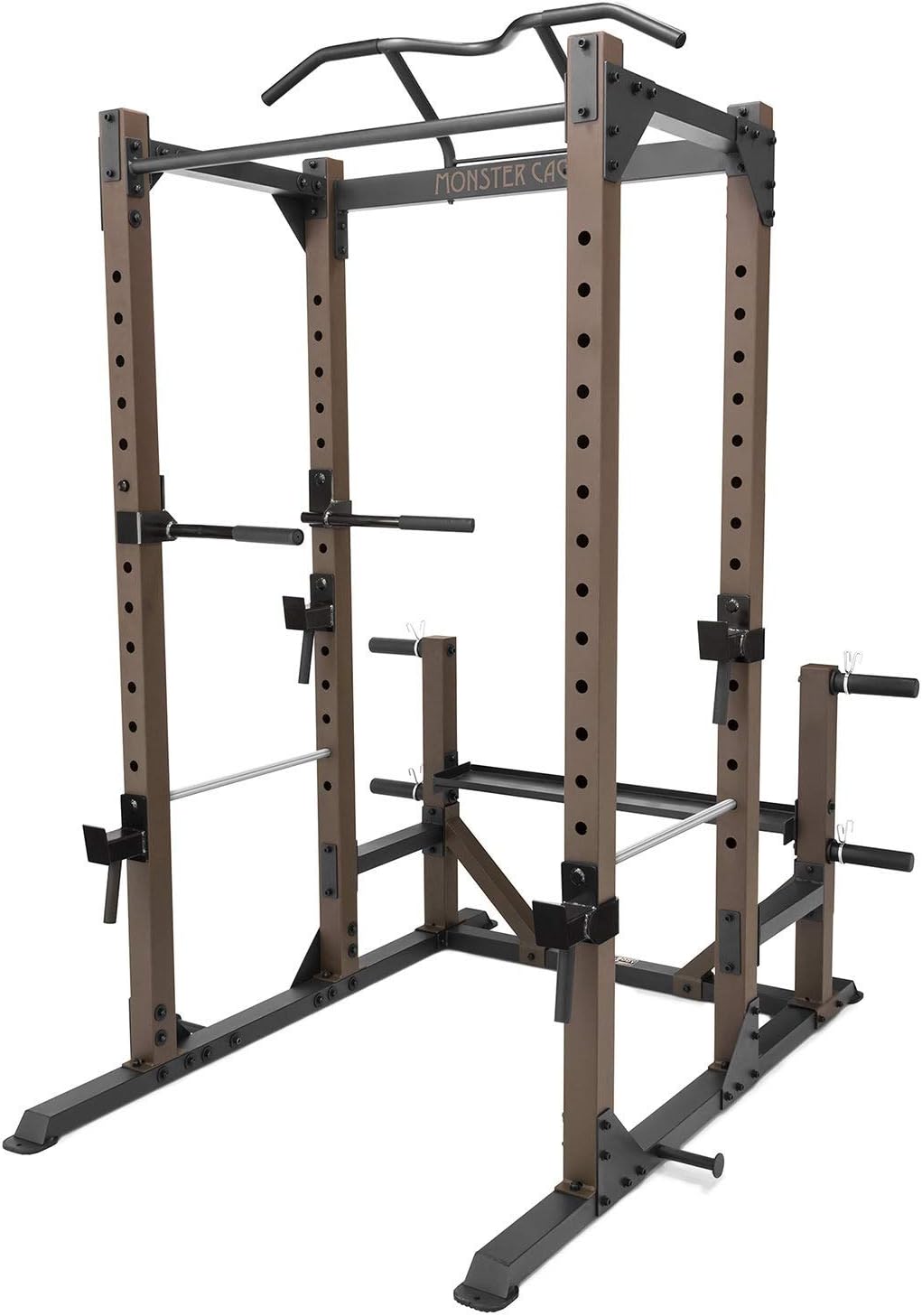
Steelbody Monster Cage
Check the current listing price live price, May 2026
Stock checked May 14, 2026. Re-verify on the listing before ordering.
The Steelbody STB-98005 is a rack with pull-up and dip stations, safety catches and storage. It does not establish an integrated cable-crossover recommendation: check the exact included components against the training you plan to do. The Amazon listing was unavailable on 22 September 2026.
Amazon.sg listing unavailable (checked 22 September 2026)Decision 2: how tall does the rack need to be?
Height is the single feature compact racks fake. They photograph well against a 2.4 m ceiling, hit the height ceiling on every overhead press, and are quietly the most resold rack on Carousell in 2026.
The formula: take your standing height in centimetres, add 60 cm for fully extended arms, then add another 15 cm for plate clearance at lockout. That number is the minimum rack height for clean overhead pressing inside the cage.
| Lifter height | Minimum rack height | HDB ceiling fit |
|---|---|---|
| 165 cm | 1.95 m | Fits 2.4 m and 2.6 m ceilings |
| 172 cm | 2.02 m | Fits both, tight margin on 2.4 m for pull-ups |
| 178 cm | 2.10 m | Fits 2.4 m for press, 2.6 m for pull-ups |
| 185 cm | 2.17 m | Pull-ups need 2.6 m older HDB or BTO ground-floor unit |
If your ceiling is the standard 2.4 m on a newer flat and you are over 180 cm, you may have to give up bar-mounted pull-ups inside the cage and use a doorway bar in a different room. That is acceptable. What is not acceptable is buying a 1.7 m rack and discovering this on day three.
A note on the standard HDB ceiling heights: 2.6 m for older blocks built before the mid-1990s, 2.4 m for newer BTO units. Measure yours before ordering. A 5 cm misjudgement is the difference between cleared lockout and a head injury.
Decision 3: bumper plates, iron plates, or a mix?
Cast iron is cheap (around S$4 to S$5 per kg in 2026), bumpers are loud-friendly (around S$12 to S$15 per kg). The HDB-specific question is not which to buy, it is what proportion of each.
The argument for going all-iron: a 100 kg starter set costs S$450 to S$500. Pure savings. The argument against: drop a loaded bar on bare tile, crack the tile, scare the cat, hand the downstairs neighbour a reason to file a complaint. A loaded bar dropped from waist height hits around 85 dB at the source on iron, around 70 dB on a properly matted bumper landing.
The argument for going all-bumper: silence (well, less noise). The argument against: cost runs three to four times higher, the plates are physically larger (45 cm diameter) so the bar racks fewer plates before running out of room.
The mix that holds up in HDB rooms: one pair of bumpers in the heaviest working-set weight you currently use (often 15 kg or 20 kg per side), cast iron everywhere else. The bumpers absorb the dropped sets that cause complaints. The iron handles warm-ups and the smaller incremental weights where dropping is not in the script.
Decision 4: flooring is not optional
The cheapest decision on the list and somehow the most commonly skipped. Bare HDB tile under heavy plates chips inside a month. Tile repair runs S$80 to S$150 per chip, and most pre-2015 HDB tile lots are out of stock, so the replacement will not match.
Two layers are needed, not one. A 20 mm rubber platform under the rack feet spreads point load across more square footage. A 6 mm interlocking rubber tile mat covers the actual training zone (typically 2 m by 2 m). The 20 mm layer protects the structure. The 6 mm layer protects the tile and drops noise transmission.
Total cost for both layers covering a 2 m by 2 m platform runs S$150 to S$220 at Decathlon or Shopee. That number is small enough that it gets cut from the budget. It is also the difference between a working room and one cracked tile that the next tenant will charge against your deposit.
Decision 5: accessory integration, planned or bolted-on?
Decision 1 already half-answered this one. If you chose the cage + integrated cable architecture, decision 5 is mostly done. If you chose a basic full cage, decision 5 is still open.
The pattern: most starter racks handle bench and squat and nothing else. Four months in, the owner misses lat pulldowns and cable rows, buys a separate cable tower for S$400 to S$800, and finds the bolt holes do not line up. The generic Lazada adapter does not fit either. Bolt-on attachments are brand-locked. Rogue parts do not fit Bowflex frames, generic Lazada parts do not fit any specific brand reliably.
If your training includes cable work, compare a rack with a manufacturer-approved cable system against a separate cable station. Confirm attachment compatibility and total space before ordering. The Steelbody rack described above should not be treated as including a lat tower or cable crossover.
If your training is strictly bench, squat, deadlift, overhead press, and pull-ups, decision 5 is closed. A basic full cage at S$1,200 to S$1,500 covers it.
Secondary features that did not earn their own decision
A few buying factors come up but do not move the build order. They sit downstream of the five decisions above.
- J-cup material. UHMW plastic liners prevent knurling damage to the bar. Bare steel J-cups eat the knurling over a year. Liner upgrade kits cost S$30 to S$50 and pay for themselves.
- Westside hole spacing. 25 mm spacing through the bench-press zone, 50 mm everywhere else. Lets you fine-tune J-cup height between bench and squat. A nice-to-have, not a deal-breaker.
- Bar choice. A 20 kg Olympic bar with a 200,000 PSI tensile rating handles everything you will lift at home. Cheaper bars bend under 140 kg. Decathlon and Lazada both stock decent options around S$200 to S$400.
- Bench selection. Buy this after the rack, not before. The bench has to fit the J-cup heights on your rack, and most flat-incline benches are slightly different in pad height. A pad mismatch breaks bench-press setup.
- Mirror placement. Side wall, not front wall. Front-wall mirrors mean you watch yourself instead of the bar. Side mirrors let you check elbow flare on bench and hip drive on squat. Both are 1.6 m tall minimum.
Buy local or ship in?
Three sourcing channels show up: local distributors (Decathlon, Speedmaster, FitnessHub), regional online (Lazada, Shopee, Amazon SG), and direct US import (Rogue, Rep Fitness).
Request a delivered and installed quote for the exact rack from each seller. Compare the box dimensions with your lift and doorway, confirm who handles warranty work locally, and include any collection or return charges. A cheaper product price alone does not establish the cheaper purchase.
For plates and bars, regional online is fine. Cast iron is commodity, and Carousell is fine for used iron (40 to 60 percent off new, no degradation with use). For the rack, the used market is a trap. Used racks are usually being sold because the previous owner hit the height or features ceiling described above, which means their decision-1 mistake becomes yours. Inspect for crossbar flex and weld integrity at the foot joints if you go used anyway.
Final thoughts on order of operations
Tape the rack footprint out on the floor first. Walk around it. Sit on a chair where the bench will go, mime a bench press, mime a squat unrack. Leave one full metre of clearance behind the rack for landmine and rear-foot-elevated split squats. Dry-run the cable from the rack to the wall socket. Drill nothing for two weeks.
Then buy the rack. Then plates and bar. Then flooring (paradoxically last to install, but already on order). Then the bench. Everything else after. If a friend offers you a "great deal" on a S$280 compact rack before you have done this exercise, the polite refusal is the most valuable thing in the article.
Common questions
What if I am 175 cm and my ceiling is 2.4 m?
A 2.05 m rack fits with usable headroom for overhead pressing. Pull-ups will be tight, the bar sits around 2.1 m and a 175 cm lifter at full hang clears 2.05 m. Use a separate doorway bar in another room for pull-ups and keep the rack at 2.05 to 2.10 m for press clearance.
Can my HDB floor actually hold a loaded power rack?
Before installing a rack, confirm the suitability of the floor and any anchoring with the relevant building authority or a qualified structural professional. Provide the equipment weight, loaded weights, user weight and intended activities. A rubber mat does not establish structural capacity.
What order should I buy plates in?
Two each of 20 kg, 15 kg, 10 kg, 5 kg, 2.5 kg, and 1.25 kg. That loads the bar to 107.5 kg, enough for most lifters' first 6 to 12 months of progressive overload. Buy the heaviest pair (often the 20 kg) as bumpers, the rest cast iron for warm-ups. Add another pair of 20 kg bumpers when the working sets get there.
Is a wall-mount folding rack a real option for HDB?
Only if you are mounting into a structural reinforced concrete wall, not a partition wall. Most HDB internal walls dividing bedrooms are non-structural; the bolts will pull out under load. The structural walls (typically the wall shared with the staircase or external facade) are bolt-safe. Verify the wall type with a contractor before ordering. If both walls in your gym room are partition, skip the folding rack.
Should I buy used on Carousell?
Plates, bar, and bench: yes. Commodity items, no degradation with use, the 40 to 60 percent discount is real. Rack: no. Used racks are usually being resold because the seller hit the height or feature ceiling. Their decision-1 mistake becomes your decision-1 mistake at a S$200 discount. A rack listed under S$400 is a warning, not a deal.
What if I might move within 18 months?
Do not build. A full cage weighs around 90 kg assembled, takes most of a day to break down and reassemble, and the bolt threads loosen with each cycle. Movers charge by item. ActiveSG at S$15 a month for 18 months costs S$270, less than the move alone would cost on a rack. Use the gym directory to find a public option near your current address and revisit the build decision after the housing stabilises.
Prices and stock checked May 14, 2026. Re-verify on listings before ordering.
Affiliate disclosure: Gyms.sg earns a commission on qualifying purchases at no additional cost to you. Local distributor and ActiveSG references are unaffiliated.
Related Guides
Ultimate $5000 Home Gym Build Singapore 2026
Ultimate $5000 home gym build for Singapore in 2026 , premium power rack, bar, plates, cardio, and accessories
Home Gym Setup Under $1000 Singapore: Complete Guide
Home gym setup under $1000 in Singapore , exactly what to buy (and what to skip) on a tight budget so it pays
Home Gym Setup Under $2000 Singapore: Serious Lifter's Build
Home gym setup under $2000 in Singapore for serious lifters , rack, bar, plates, and bench that take heavy wor
Compact Home Gym Singapore Small Spaces
How to build a compact home gym for HDB living that fits in 0.5 sqm , the equipment that earns its space and w