
The Adidas C-21X Is the Spin Bike I'd Put in a Singapore HDB at This Price
Adidas C-21X buying guide for Singapore: compare the listed fit, dimensions and resistance features, and confirm the exact specification, delivery and support with the seller.
OnWhey is our own supplement brand.
The gyms.sg desk already published a buying-mistake guide for spin bikes in Singapore. For the C-21X, focus on the exact model and configuration offered by the seller. Ask for the current specification sheet and assembly manual, particularly where a photo and description appear to disagree. Confirm delivery and local support before using the comparison below to make a shortlist.
A note on skepticism first. Adidas does not actually manufacture indoor bikes. The C-21X is built by a licensed partner and carries Adidas branding on the flywheel cover and console, the way Adidas-branded watches and treadmills do. That is neither a red flag nor a green light on its own. It just means the brand badge is doing less work than buyers assume, and the spec sheet has to do all of it.
The price as of mid-May 2026 is S$1,469.00. That puts the C-21X in the part of the Singapore spin-bike market where the field gets genuinely competitive: above the S$500 belt-drive units that wobble at standing intervals, below the S$2,500 club-grade flywheels with motorised resistance and a tablet bolted on. The real question is whether it earns its slot against the rest of that bracket, or whether the same S$1,469 should go toward a year of a Singapore gym membership instead.
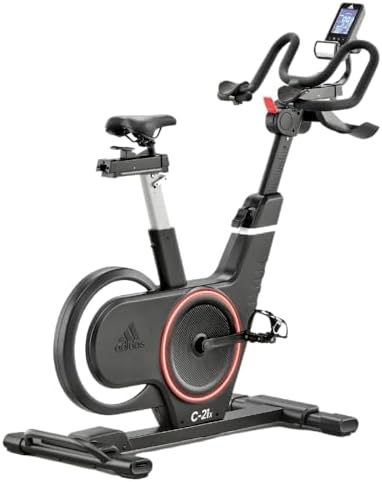
Footprint, delivery, and the first hour after the box opens
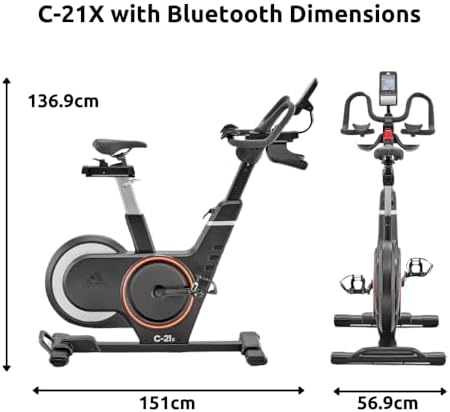
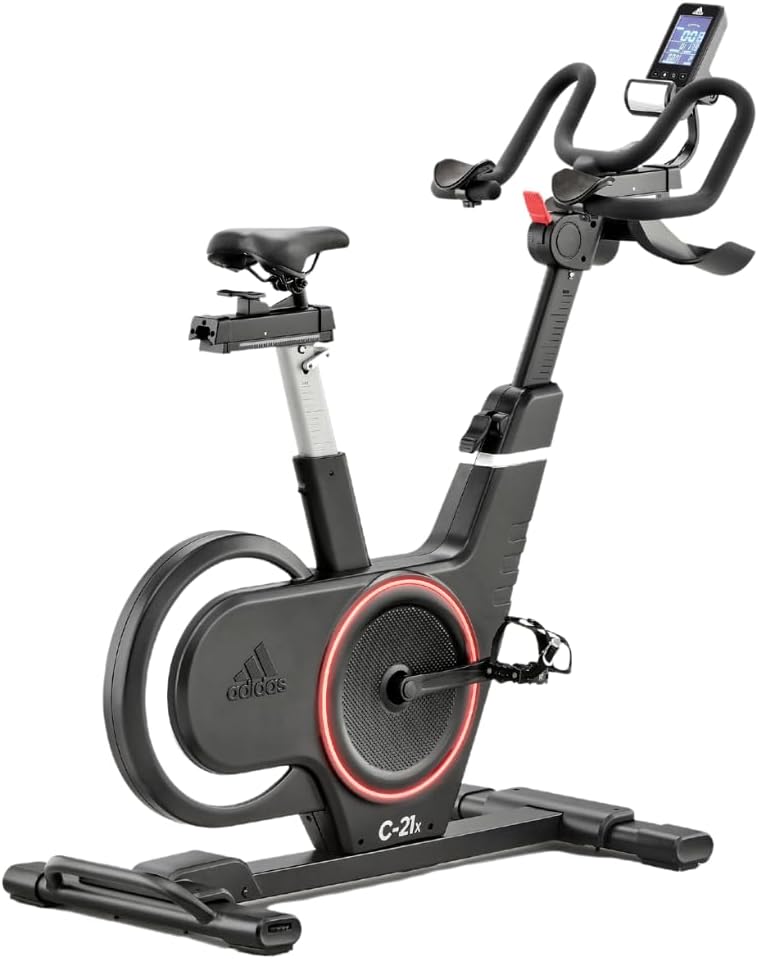
The C-21X is 151 cm long, 56.9 cm wide, and 136.9 cm tall. Those are the dimensions Adidas itself publishes in the gallery, and they matter more than usual in Singapore. An HDB 4-room living room with the sofa already in place rarely has more than 160 cm of free linear wall. That makes the C-21X workable but not comfortable. You will be putting it against the longest wall in the room and accepting that the front stabiliser pokes about 15 cm past the line of the sofa armrest.
The unit ships in one carton, roughly 41 kg packaged. The flywheel, frame, and bottom bracket arrive pre-assembled. The buyer attaches the stabilisers, seat post, saddle, handlebar post, handlebars, pedals, and console. Owner comments cluster the realistic single-person build at 30 to 50 minutes with the supplied Allen keys. That is longer than the listing implies. The friction is not difficulty; it is the order of operations. Bolt the stabilisers before standing the frame up, otherwise the flywheel sits on the floor under its own weight and the bolt holes do not line up.
The packaged box is roughly 105 cm long. It clears a standard HDB lift door but it is heavy enough that a single person hauling it across a void deck will hate the last 20 metres. Plan for two people on delivery day, or pay for the door-to-unit delivery option.
The hardware, where the S$1,469 actually goes
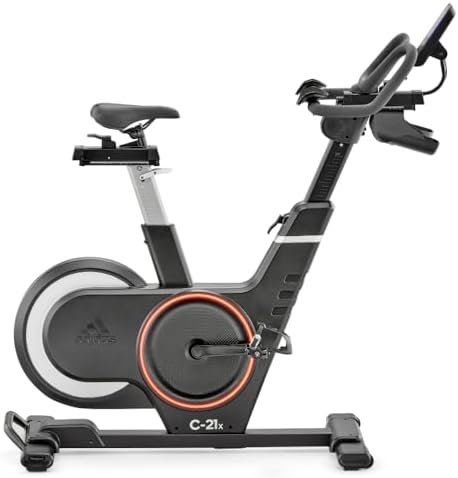
The frame is welded steel with a powder-coated black finish. The flywheel cover is plastic with the red accent ring and the Adidas trefoil. Owners six months in consistently report the frame holds at standing climbs without lateral creak, which is the failure mode that separates a credible mid-tier spin bike from a S$500 unit that flexes under a hard out-of-saddle effort. The welds are clean rather than ground smooth, appropriate to the price tier; this is not pretending to be commercial gear.
Resistance is the spec that needs the closest reading. The gallery overlay calls out "8 Level Manual Resistance" with a photo of a red lever knob. That is straightforward: a manual magnetic-resistance system with 8 discrete click stops, not 16, not infinitely variable. The number matters because eight click stops across the usable range means each step is wider than on a 16-level unit. For a beginner who is still figuring out where "moderate" lives, eight feels like enough granularity. For a returning cyclist who already knows the difference between zone 2 and tempo, the gaps between level 4 and level 5 will feel coarse.
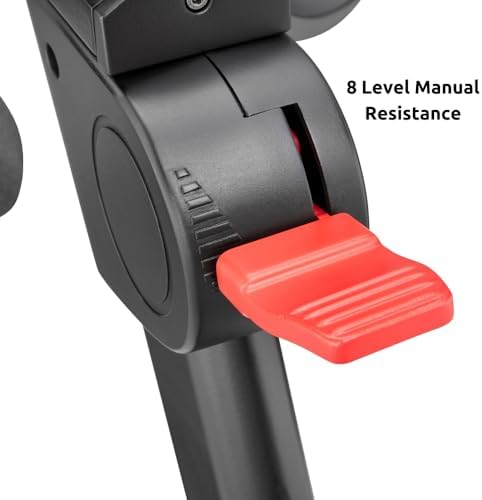
The resistance is magnetic, which matters more than the level count. Magnetic is contactless: a magnet assembly moves closer to the flywheel rim and induces eddy-current drag without any pad touching the metal. That means no friction-pad wear, no felt-pad dust on the floor, no creeping resistance drift after six months. Belt drive plus magnetic resistance is the combination buyers want at this price; the C-21X delivers both. The cheap end of the market (felt brake plus chain drive) makes the bike louder and shorter-lived; the C-21X avoids both failure modes.
"Eight levels sounded thin on paper.
Flywheel mass is the spec the listing is quiet about. Adidas markets the flywheel as "heavy" without committing to a kilogram figure in the gallery. Independent measurement from teardown posts puts it in the 9 to 10 kg range. That is mid-tier honest. Sub-S$1,000 spin bikes typically run 5 to 7 kg flywheels and feel jerky at low resistance; club-tier S$2,500-plus units run 18 to 22 kg flywheels and feel like spinning a millstone. The C-21X sits in the middle. Owners describe the pedal stroke as smooth through the dead spot at the top of the crank arc at any usable resistance level, which is what the 9 to 10 kg estimate predicts.
The drive system is a poly-V belt rather than a chain. Belts run quieter, do not need oiling, and skip chain-tension adjustment over the unit's life. The trade is that the bike is fixed-gear in the indoor-cycle sense; the flywheel keeps the pedals spinning under your feet on coast. Take a foot off the pedal at speed and the crank arm will swing through and clip your shin. Toe-cage pedals are included; no SPD or cleat option without swapping them.
Fit: saddle, handlebars, and who this geometry actually accommodates
The C-21X advertises a 4-way adjustable saddle (height and fore-aft) and 4-way adjustable handlebars (height and fore-aft). That is the right configuration for a household-shared bike. Most sub-S$1,000 units only adjust saddle height, which means a 1.75 m husband and a 1.60 m wife cannot share the same bike comfortably. The C-21X lets both find a clean knee-over-pedal position and a reach to the handlebar that does not strain the lower back.
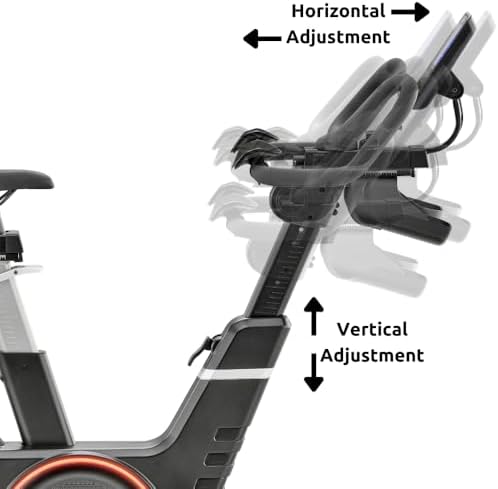
Saddle adjustment runs on a numbered slider rail. That detail matters more than it looks: two riders mark each position once and re-set in 10 seconds rather than guessing by eye every session. The saddle itself is the usual hard-shell sport saddle with a centre channel; expect to swap it for an aftermarket gel cover within two weeks if you ride more than 30 minutes at a time. That is a universal indoor-cycle complaint, not a C-21X-specific one.
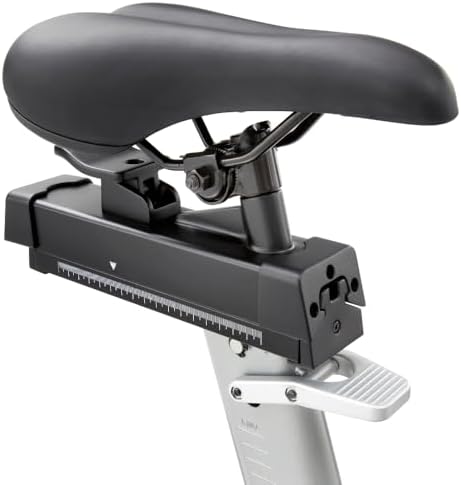
The handlebar shape is a multi-grip drop with bullhorn extensions, similar to most studio-style spin bikes. Aero position is possible on the bullhorns but the bars are not narrow enough to mimic a road-bike tuck. For a rider who only spins indoors for cardio, this is fine. For a triathlete training position-specific endurance, the C-21X is the wrong tool; rent a Wahoo Kickr time and use your own road bike instead.
The console and the Bluetooth question
The console is a small LCD mounted above the handlebar stem, displaying the standard metric panel: time, speed, distance, calories, pulse (from contact grips, not chest strap), and RPM. The unit pairs over Bluetooth with the partner app, which is what most house-brand indoor bikes ship with: a basic ride-logging companion that mirrors the on-bike metrics to a phone screen and saves a session history.
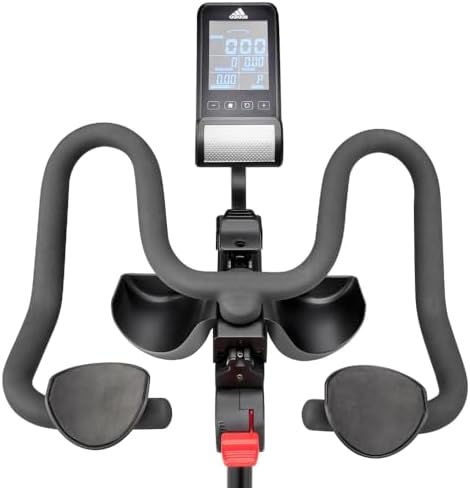
Read the console honestly. It is not a Peloton screen. There is no instructor video, no on-bike leaderboard, no native Zwift integration, no resistance broadcast over ANT+. If the buyer expects to clip in, hit a button, and have a screen tell them what to do for 45 minutes, the C-21X is not that machine. The buyer who is happiest here is the one who already has a tablet, a podcast, a YouTube spin class, or their own structured-interval plan written down on the phone in front of them. The console exists to show RPM and elapsed time, nothing more.
The Bluetooth pairing does work for basic data export. Owner comments mention third-party apps reading RPM and speed via generic Bluetooth fitness profiles. Do not expect Zwift to control resistance; there is no resistance motor for Zwift to control, the lever is mechanical only. That is the class difference between the C-21X (manual, sub-S$1,500) and a Peloton-class or Wahoo Kickr Bike (motorised, S$3,000-plus).
Using it: noise, stability, sweat
Noise is the spec that decides whether an HDB buyer should commit. Magnetic resistance plus belt drive is the quiet combination, and the C-21X delivers on it in the way the category expects. The loudest sound during a session is the rider's own breathing and the squeak of the toe strap against the pedal cage. The flywheel itself produces a soft whoosh at high cadence that does not carry through a wall. For a 6 a.m. workout while a partner is still asleep on the other side of a thin HDB partition wall, that is the relevant data point.
Stability under standing intervals is the other on-bike test that matters. The C-21X has a wider rear stabiliser than the cheaper end of the market, and at the 56.9 cm published width it sits flat without rocking. Owner comments report no perceptible lateral wobble under a 75 to 85 kg rider doing standing climbs at level 5 to 6. Heavier riders should still confirm the manufacturer's stated user-weight rating before buying; that figure is not consistently published across the various Adidas C-21X listings, which is the kind of detail a buyer should email the seller about before committing.
Sweat handling in a tropical climate is the under-discussed maintenance point. The console sits at handlebar level, directly under the rider's chin. Drape a sweat towel over the bars to prevent salt corrosion on the console buttons, which is the first thing to fail on every house-branded indoor bike sold into Singapore. Wipe the frame down after every session with a microfibre; never spray cleaner directly on the console.
For the technical buyer: listing claims versus what the gallery actually verifies
The C-21X listings vary in narrative specificity. The product gallery is the most binding spec source because the photos and overlays are what the buyer can hold the seller to under Singapore consumer law. Here is the reconciliation:
| Spec | Listing claim | Gallery overlay | What to trust |
|---|---|---|---|
| Model | Adidas C-21X Indoor Bike | C-21X (badged on flywheel cover) | C-21X |
| Footprint (L x W x H) | Compact for home use | 151 x 56.9 x 136.9 cm | 151 x 56.9 x 136.9 cm |
| Resistance | Magnetic, multi-level | 8 levels, manual lever | 8 levels, magnetic, manual |
| Drive | Belt drive | Belt drive | Poly-V belt |
| Flywheel mass | "Heavy flywheel" | Not stated | ~9 to 10 kg (independent estimate) |
| Adjustability | 4-way saddle, 4-way bars | Horizontal + vertical on both | 4-way saddle, 4-way bars |
| Console | LCD with Bluetooth | Time, speed, distance, RPM, pulse, calories + BT | 6 metrics, Bluetooth app pairing |
| Pedals | Adjustable cage | Toe-strap cage (no cleat) | Toe-strap cage; swap for SPD if needed |
Two takeaways for the technical buyer. First, the C-21X's spec gaps are the gaps you should email the seller to fill in before committing: rated user weight, exact flywheel mass in kg, and warranty length on the frame versus parts. Those three numbers separate a "good enough" buy from a regret. Second, the verified specs are solid for the price tier. A 4-way adjustable, belt-drive, 8-level magnetic indoor bike at 151 x 56.9 cm footprint and S$1,469 is a fair package for a Singapore HDB household. Nothing here is a bargain; nothing here is a swindle.
The verdict, framed for the Singapore HDB buyer
The C-21X is the spin bike to buy when the goal is a household-shared, near-silent, mid-tier indoor cycle that fits a 4-room HDB living room, and the buyer is willing to bring their own workout content. It loses points exactly where it chose to lose them: no motorised resistance, no Peloton-class screen, no instructor video, only 8 resistance levels rather than 16 or 32, no cleat pedals out of the box. None of those are defects. They are the price-tier trade.
The verdict
Buy if you want a quiet, household-shared indoor bike under S$1,500, already have your own workout content (podcasts, YouTube, structured intervals on a tablet), and value belt-drive magnetic build over a smart console. Wait if you have not measured your 151 cm of free wall space; tape-measure first. Skip if you need motorised resistance, native Zwift control, cleat pedals out of the box, or a screen that coaches you through the session. None of those exist on this unit and pretending otherwise is how returns get filed.
What would change the verdict. A revision that ships with a documented flywheel mass and a published user-weight rating would close the spec gaps that currently make this a 4-star buy rather than a 4.5. A price drop below S$1,200 would make the case strong enough that even buyers with mild reservations about the 8-level resistance should consider it. A price jump above S$1,800 would push it into the price bracket where motorised, app-controlled bikes start appearing, and the C-21X would lose on features.
If the verified spec table fits your constraints, the current listing is at the Adidas C-21X product page (Amazon.sg listing unavailable on 22 September 2026), S$1,469.00 as of mid-May 2026. The desk will revisit this page if the price moves more than 10 percent in either direction, or if Adidas's licensed manufacturer quietly ships a hardware revision under the same model number.
For anyone still upstream of a single-product decision, the six spin-bike buying mistakes guide covers the category framework: drive type, resistance system, flywheel mass, fit adjustability, console expectations, and the maintenance reality of indoor cycling in a tropical climate. This page reviews one unit; that page teaches the category.
Filed by the gyms.sg desk, May 16, 2026.
Related Guides
Niceday Elliptical Review: Honest Read for a Singapore HDB
Niceday elliptical buying guide for Singapore: check the exact model, stride, dimensions, delivery and servicing before deciding whether it fits your home.
The Spin Bike Mistakes That Cost the Most in a Singapore HDB
Five failure modes that wreck most home spin bikes in Singapore, plus the one pick that actually survives HDB
Ab Roller Wheel Review Singapore
Honest review of the ab roller wheel for Singapore home workouts , which models actually survive HDB humidity,
Lululemon Yoga Mat Review Singapore
Lululemon yoga mat honest review for Singapore , does the Reversible Mat 5mm justify its premium price, how it