
Exercise During Haze: Check the Right Air-Quality Reading
The 1-hour PM2.5 reading and 24-hour PSI forecast answer different planning questions. Check the official advice for your activity and health group before deciding whether to head outside.
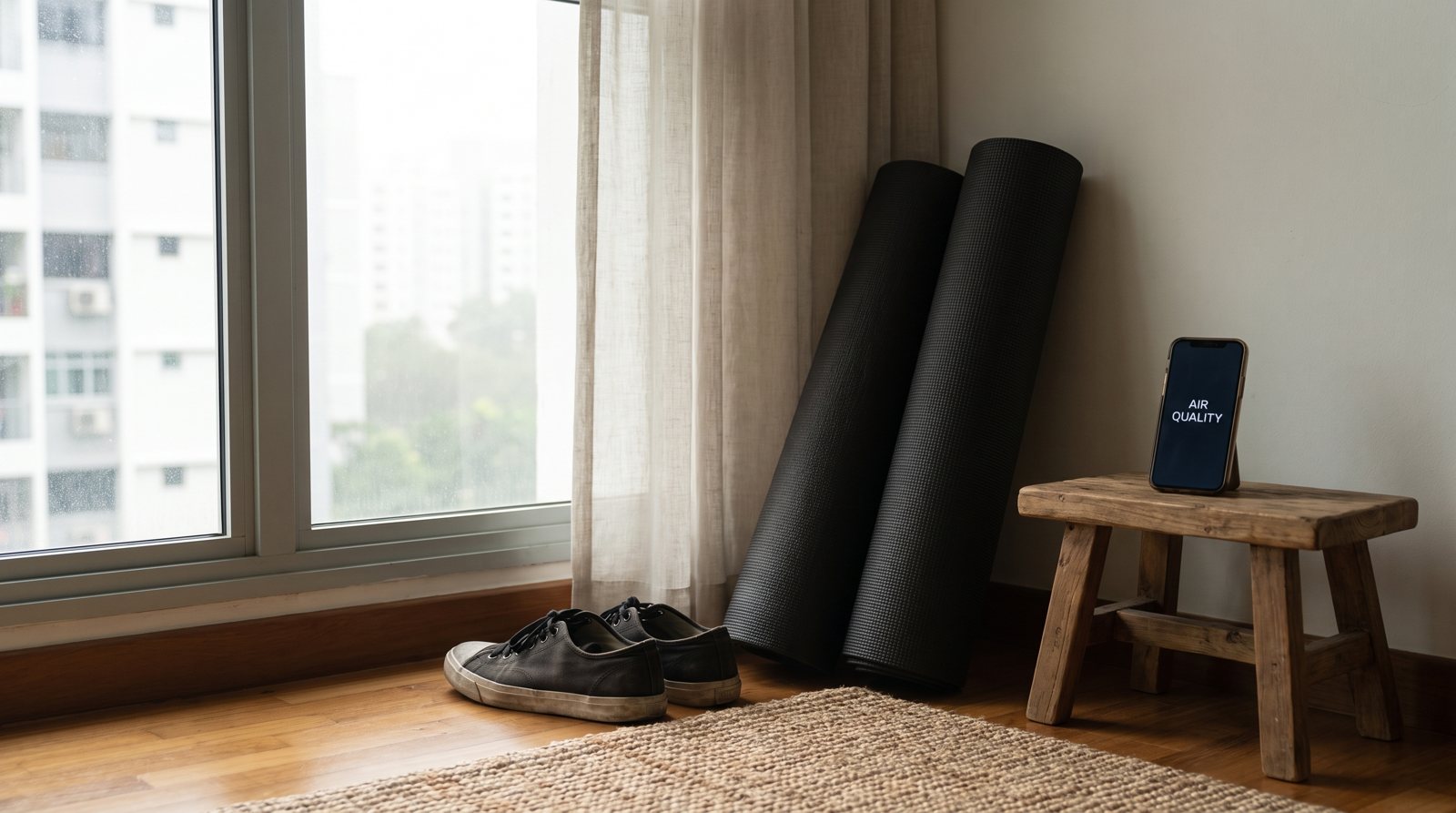
Before an outdoor workout during haze, check the latest 1-hour PM2.5 reading and the accompanying personal guide for your region. For tomorrow's plans, use the 24-hour PSI forecast and health advisory. They answer different questions, so a single “PSI below 100” rule is not enough.
Start with NEA's current air-quality readings. Check the time, region, measure and advice together. This article helps you make that check and prepare another option; it does not report today's conditions.
Which air-quality reading should you check?
The official outdoor-activity guide distinguishes immediate plans from next-day decisions. Use the latest 1-hour PM2.5 concentration before heading out, and monitor it again if your activity is later. Use the 24-hour PSI forecast for planning the following day.
| Your question | Official information to open | What to check |
|---|---|---|
| Should I head out now? | Latest 1-hour PM2.5 concentration and personal guide | Your region, timestamp, band and guidance for your health group |
| What should I plan for tomorrow? | 24-hour PSI forecast and health advisory | Forecast range and the activity advice for your health group |
| Has my plan changed since this morning? | Latest reading and any updated advisory | Recheck before leaving; do not rely on a saved screenshot |
PM2.5 concentration is expressed in micrograms per cubic metre; PSI is an index. NEA explicitly distinguishes its 1-hour PM2.5 reading from a “1-hour PSI”. Do not transfer a numerical threshold from one measure to the other. NEA's air-quality FAQs explain the difference and which region to use.
How does the advice change with air quality?
The immediate-activity guide has four PM2.5 bands: Normal at 0 to 55 µg/m³, Elevated at 56 to 150, High at 151 to 250, and Very High from 251. Read the action beside your band in the NEA personal guide, including its separate advice for vulnerable people. These numbers are PM2.5 concentrations, not PSI values.
For longer planning, MOH's haze advisory gives different activity advice by health group. For healthy people, a 24-hour PSI of 101 to 200 calls for less long-duration or demanding outdoor exercise. At 201 to 300, that type of exercise should be avoided; above 300, time spent active outdoors should be kept to a minimum.
Older people, pregnant women, children, and people with chronic heart or lung disease need to use the relevant row of the advisory. Its advice is more restrictive for those groups as conditions worsen. MOH says individual responses vary and advises people who feel unwell to seek medical advice, particularly those in these groups.
A reading is not a personal medical clearance. Follow advice from your clinician where you have a condition or an individual care plan. Do not turn a general haze table into a new medication schedule or a target heart rate.
What is a useful backup plan?
Prepare the alternative before you leave: postpone the session, change to a suitable indoor activity, or take a rest day. Which option fits depends on the official advice, how you feel and the indoor setting available. Moving a difficult workout inside does not automatically make it appropriate.
For a booked class, check the organiser's latest notice before travelling. Ask whether it is running, where it will take place, and what happens to your booking if conditions change. Save the reply if you need to rearrange a session. A class remaining on a timetable is not evidence of the air quality at that venue.
Keep the plan simple enough to change. You might reserve another training day instead of committing to a long journey to replace a single run. Do not add extra sessions later solely to repay a missed workout.
Is an air-conditioned gym enough?
Air-conditioning alone does not establish a gym's particle levels. NEA's air-cleaning guidance explains that air-cleaning capability and the size of the space matter. A portable cleaner's presence is not proof that an entire training floor has suitable filtration.
Ask the branch what haze measures are operating now. Useful questions include whether the training space is enclosed, how outside air is managed, what filtration is in use, and whether any recent indoor particle measurements are available. If a reading is offered, ask where and when it was taken.
Those questions help you obtain information; they are not a certification checklist. A membership price, chain name or hotel setting cannot answer them. Use the gym directory to find a nearby operator, then confirm the branch's arrangements directly before making a special trip.
What can you do at home?
NEA's household haze advice includes shutting windows and doors when outdoor air worsens, reopening them when conditions improve, and limiting indoor pollution from sources such as smoking or candles. It also discusses air cleaners suited to the room. Follow the full guidance for your setting.
If you are arranging a regular indoor training space, use the home gym planner to record space, storage and the equipment you actually need. It is a layout worksheet, not an air-quality assessment or a reason to buy equipment during a haze episode.
What should you check just before leaving?
- Open the official readings and confirm the region and timestamp.
- Read the accompanying advice for the correct measure and your health group.
- Check how you feel and follow any individual medical advice.
- Confirm the venue or organiser's latest arrangements if you are travelling.
- Keep postponement or another suitable plan available if conditions change.
Bookmark the official haze update rather than saving a screenshot of today's number. The decision belongs to the conditions when you train.