
Water vs Air Rowing Machine: Which Is Better? (2026)
Air rowers run at 70 to 85 decibels and water rowers slosh in the mid-60s, which is why apartment rowers usually end up with neither. The quiet answer is the magnetic YOSUDA at S$461.46, rated 4.4 across 1,929 reviews.
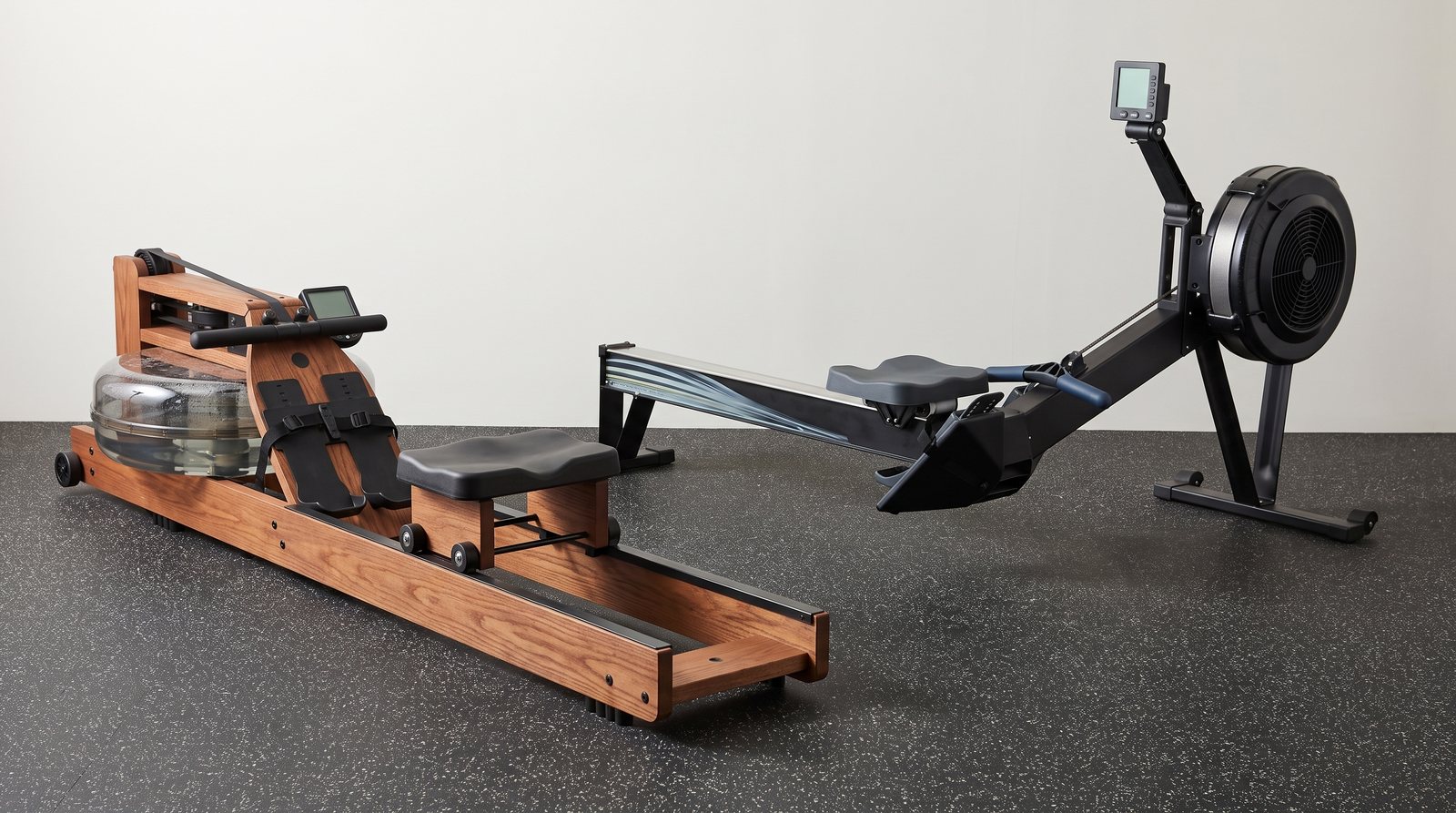
The water-versus-air rowing debate has a trick ending: for most people rowing at home, the right answer is neither. Air rowers run at 70 to 85 decibels, about the level of city traffic, and water rowers slosh along in the mid 60s, but a wall-shared bedroom or a sleeping baby doesn't care how authentic your catch feels. Magnetic resistance runs at roughly 40 to 55 decibels, quieter than conversation, and that's why the machine to buy for a flat is the YOSUDA magnetic rower: 4.4 stars across 1,929 Amazon ratings, 16 resistance levels, and it stands upright in a corner when you're done.
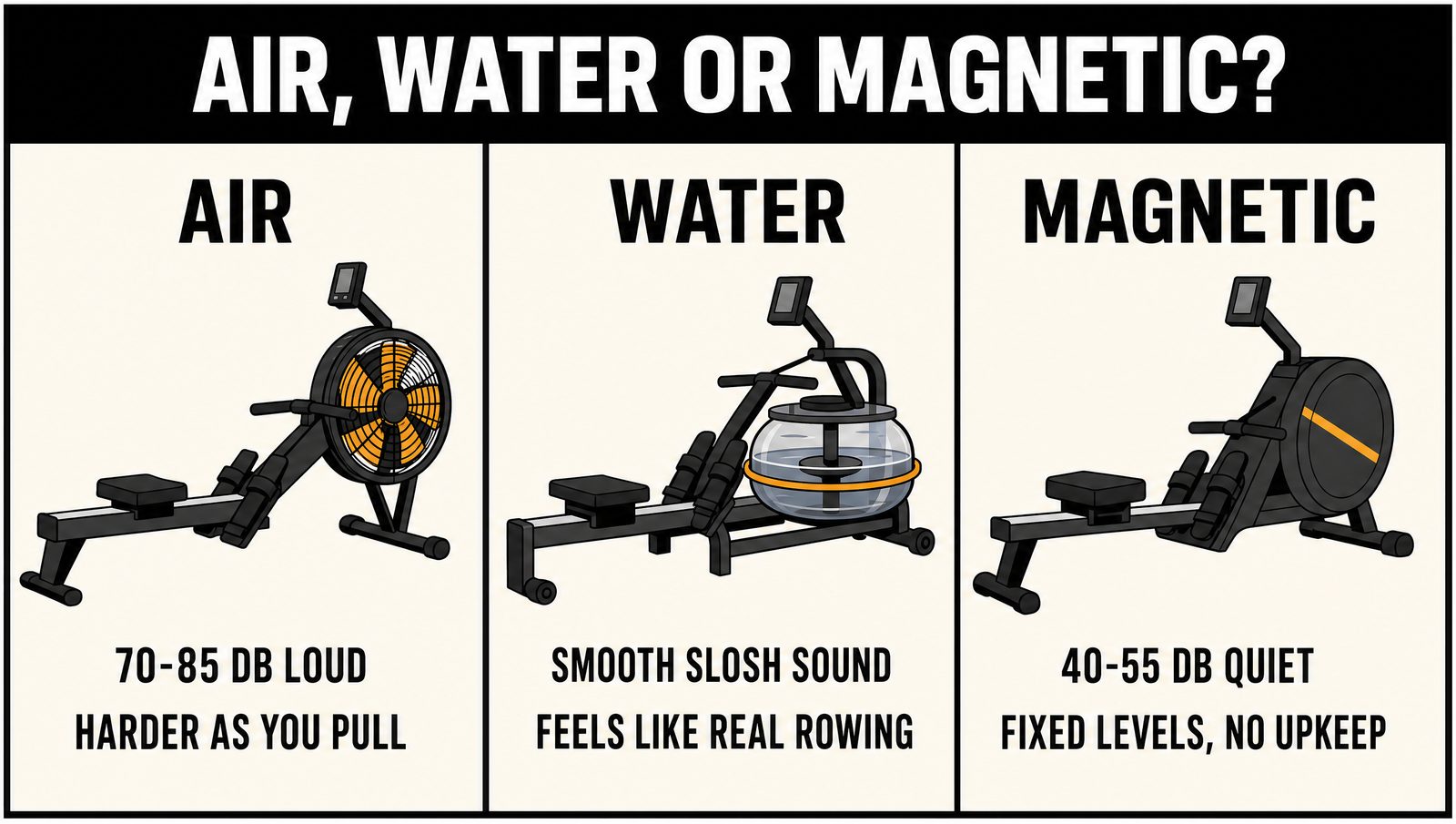
The three resistance types in one look: air gets harder the faster you pull and roars while doing it, water feels closest to a real boat, magnetic stays quiet and needs nothing from you.
That's the verdict for the typical home buyer, and the rest of this page earns it. Air and water both still win for specific people, and if you're one of them you should absolutely buy accordingly. The differences are mechanical, not marketing, so once you know how each type makes its resistance, the choice mostly makes itself.
One warning before the details, because it catches real buyers: the YOSUDA above is sold under a "Magnetic/Water" listing name, but the S$461 machine is the magnetic model, full stop. The spec table says so and there's no tank on it. YOSUDA uses the shared name across a product family, and review sites list the confusion itself as a con. Check the spec table, not the title, on any rower listing.
How each type actually makes resistance
Air scales with effort. A fan flywheel spins against the air, so the harder and faster you pull, the more resistance you get, with no ceiling. That self-scaling is why the air-resistance Concept2 is the standard at gyms and indoor rowing competitions: sprints get brutally hard exactly when you want them to. The cost is noise that rises with intensity, and there's no volume knob for physics.
Water works the same way, wetter. A paddle spins in a sealed tank, resistance builds with stroke speed, and the mass of the water gives the stroke a heavy catch and a smooth glide that's the closest thing to a real boat. Owners tend to love the rhythmic slosh. The tank is also maintenance: purification tablets on a schedule, an eye on the water level, and the occasional drain and refill.
Magnetic is fixed and silent. Magnets brake a metal flywheel without touching it, so you pick one of a set number of levels and it stays constant no matter how fast you row. No contact means near-silence and basically zero upkeep. The trade is at the top end: on budget magnetic rowers the hardest level often isn't hard enough for a strong, experienced rower, which is the honest limit of the type.
The three types at a glance
| Type | Noise | Resistance feel | Upkeep |
|---|---|---|---|
| Air | 70 to 85 dB | Scales with effort, no ceiling | Chain oiling every ~50 hours |
| Water | ~55 to 65 dB slosh | Boat-like catch and glide | Tank tablets, occasional drain |
| Magnetic | 40 to 55 dB | Fixed levels, softer top end | Essentially none |
Those noise figures come from apartment-focused testing of each category, and the vibration story matches: magnetic transmits the least through the floor, which is the part your downstairs neighbour experiences. A rubber mat under any rower is standard courtesy regardless of type.
Who should still buy air or water
Buy air if you train seriously. If you row for fitness scores, follow structured erg programmes, or want the machine every reviewer calls virtually indestructible, the Concept2 RowErg is the answer and nothing else really competes. The honest catch for a local buyer: it's been out of stock on Amazon here since at least May 2026, so getting one means a specialist importer, and it needs a room where 75-plus decibels is acceptable. Landed or standalone properties, mostly.
Buy water if the feel is the point. If rowing is the sport you love rather than the cardio you tolerate, a water rower's stroke is the one that feels right, the wooden frames store upright and look like furniture, and the slosh is genuinely pleasant. You accept the tank upkeep and a mid-tier noise level as the price of the experience. Just buy an actual water rower, with a visible tank, not a magnetic machine wearing a watery name.
YOSUDA magnetic rower: the one to buy for a flat
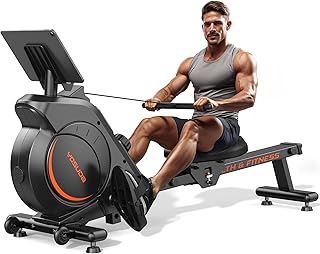
Sixteen magnetic levels and a 158kg rating; it stows upright on well under half a square metre. Image from the Amazon listing.
The YOSUDA magnetic rower (S$461.46) is the best-reviewed rowing machine you can actually buy here right now, at 4.4 stars across 1,929 ratings, and it was sitting among Amazon's rowing best-sellers at last check. The essentials are right: 16 magnetic levels, a 158kg user rating, adjustable foot straps that fit riders from about 1.35m to 1.88m, a phone-and-tablet holder, and a frame that tips upright to store on a footprint smaller than a doormat. The console runs on two AA batteries, so it lives wherever the spare corner is, no socket required.
Its limits are the type's limits plus a couple of its own. Strong rowers report level 16 stops being challenging as fitness builds, the 3.45-inch display tracks basics only with no built-in programmes, and while Bluetooth supports apps like Kinomap on your own tablet, none of that is required, and none of it is polished either. A few buyers report missing fasteners out of the box, resolved by support under the one-year warranty. For steady rows a few evenings a week while the household sleeps, all of that is beside the point, and the point is a quiet machine at a S$461 price with nearly two thousand reviews behind it. You finish a session, tip it upright, and the living room goes back to being a living room.
Or row at the gym first
If you've never rowed consistently, spend S$20 before you spend S$461: most full-floor gyms keep rowing machines, and a day pass tells you whether you'll actually use one three months from now. Fitness First Paya Lebar (4.7 stars, 716 Google reviews), Anytime Fitness Bedok 85 (4.9, 1,052 reviews) and Anytime Fitness Ang Mo Kio South (4.9, 599 reviews) are all well-reviewed places to try the movement. Our beginner rowing guide covers form basics, and the rowing machine roundup compares more models when you're ready to commit.
Common questions
Is a water rowing machine better than air?
What's the quietest type of rowing machine?
Is the YOSUDA rower actually a water rowing machine?
Do magnetic rowing machines get hard enough?
How much maintenance does each rower type need?
Updated July 2026: first published. Noise ranges from apartment-focused category testing; ratings and prices from Amazon listings; Concept2 noted out of stock locally since May 2026.