
New vs used treadmills in Singapore: when is used the better buy?
A used treadmill can offer running space or controls you prefer. Compare the exact machine, warranty, moving costs and repairs before deciding whether the saving is real.
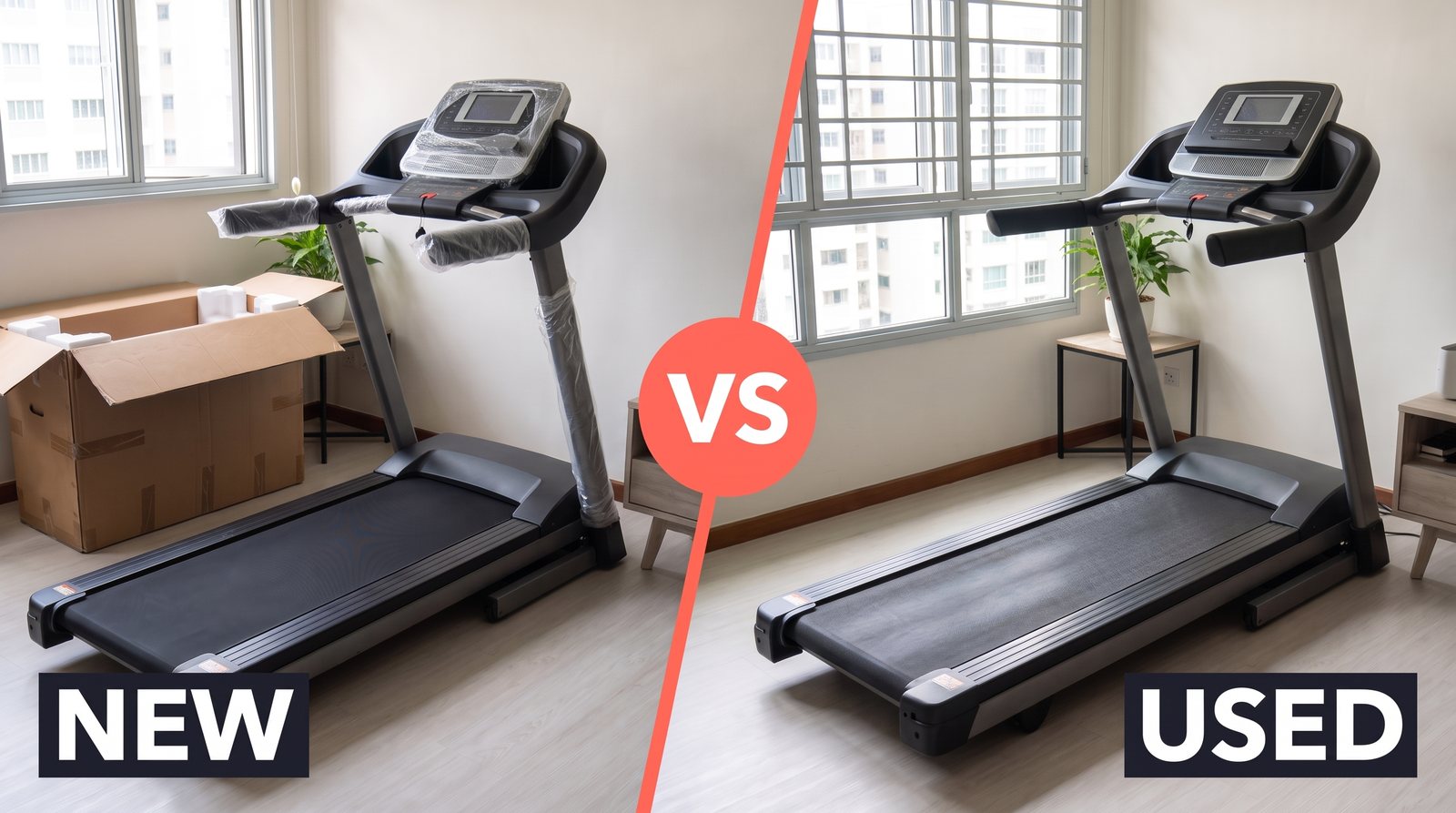
A used treadmill can be the better buy when it gives you running space, controls or features that the new models within your budget cannot, and the actual machine passes checks for condition, support and delivery. Choose new if the used option leaves you with uncertain repair costs, unsuitable dimensions or too little saving after moving it home.
The useful comparison is between two exact machines you could buy. An older treadmill does not become a good purchase just because it once cost more.
What could make a used treadmill better than a new one?
Start with what you need it to do. A walker who needs to store the machine after each session has a different shortlist from a runner who wants more room to move on the belt.
More usable running space within your budget
The running surface is the moving belt you stand on. Its length and width matter separately from the treadmill's overall footprint: a machine can take up plenty of floor space without giving you the belt space you want.
A used model is worth considering if its documented running surface fits you better than a new candidate's. Check the dimensions for the exact model and revision, then try the actual machine at a comfortable pace if the seller can arrange a safe demonstration. Do not choose a belt size from your height alone.
For example, Decathlon's RUN500 support page specifies a 45cm-wide, 130cm-long running surface for reference 8542707. That is a model-specific measurement to compare, not a minimum for every runner or proof that any used RUN500 suits you.
Controls you find easier to use
You might prefer physical speed buttons and a simple display to a large touchscreen. You might also already know a particular model from using it elsewhere and want the same controls at home.
Those are reasons to shortlist that model used. Check its manual for what works without an account, subscription or internet connection, and ask the seller to demonstrate those functions. Familiar controls do not tell you whether this particular unit has been maintained.
A function you would otherwise give up
Perhaps the used candidate has powered incline while the new one you can afford does not, or its documented folding arrangement fits your storage space better. Name that advantage before deciding that the more expensive original model is an upgrade.
A thicker-looking frame, a higher advertised motor number or the word “commercial” does not establish remaining life. If you cannot point to a feature you will use and verify that it works, the old original price adds little to the decision.
Are you comparing the same model or different machines?
| Your comparison | What used could offer | What must justify the choice |
|---|---|---|
| The same model, new and used | The same documented features for less money. | A worthwhile saving after delivery and work due, with acceptable condition and support. |
| An older, higher-spec model versus a basic new model | A running surface, control layout or function you prefer. | A verified advantage you need, without buying a machine that is too large or costly to maintain. |
| Dealer-refurbished versus privately sold used | Documented work and written cover, if the dealer provides them. | Exactly what was inspected or replaced, what the cover includes and who pays for a repair visit. |
If both candidates meet your needs, new may be worth the extra cost for the condition, returns policy or warranty actually included. Read the seller's terms; the word “new” does not answer those questions by itself.
Which choice fits your situation?
| What matters to you | When used is worth a look | When to choose new or keep looking |
|---|---|---|
| Walking and easy storage | The exact unit folds as needed and you can move and store it safely. | The used machine is awkward to fold or its stored size does not fit. A bigger machine offers no benefit if you cannot keep it at home. |
| Running room | You prefer its verified belt dimensions and feel comfortable during a safe demonstration. | The belt feels restrictive, operation is uneven, or you cannot assess it before paying. |
| Simple controls | You can use the functions you want without an unwanted subscription or missing accessory. | Required features are locked, unsupported or impossible to demonstrate. |
| No money left for a repair | Written cover includes the repair costs you cannot absorb. | A private sale consumes your entire budget and leaves you responsible for an unknown fault. A new machine also needs suitable cover. |
| You expect to move home | Its dimensions and dismantling requirements suit your likely moving route. | The purchase only works if you assume an easy future move or a particular resale price. |
Does a used treadmill have a warranty?
Some do, but you need written terms for that sale. A private seller saying “still under warranty” is not enough.
Sole Fitness Singapore's warranty policy, for example, covers the original purchaser and is non-transferable. It also excludes damage caused while moving equipment. An original receipt can help establish a machine's history without transferring that warranty to you.
Dealer cover can be different. A pre-owned Horizon T101 description on HF Lifestyle's certified pre-owned page states 12 months of cover for electronic parts and excludes delivery and installation from its listed price. That wording alone does not promise labour, every component or transport for repairs; confirm the offer and availability directly.
For either a new or used purchase, get the coverage period, covered parts, labour charges, call-out fees and repair transport arrangements in writing. Ask which Singapore service provider handles your exact model and whether the parts it may need can still be supplied.
How much cheaper is it after you get it home?
Put both options on the same basis. Compare the new machine's delivered and assembled cost with the used machine's purchase, moving, assembly and any work already identified.
- Purchase: the agreed amount for the exact unit and included accessories.
- Moving: collection, transport, stairs and any dismantling or reassembly.
- Known work: a written quote for faults or overdue servicing identified before purchase.
- Money kept aside: what you can afford to retain for uncovered problems. This is a personal budget decision, not a prediction of repair costs.
Compare the purchase, moving and known work first. Then consider how much money you need to keep available for uncovered problems with either option. If a fault has not been diagnosed, mark its cost as unknown instead of entering zero.
Illustration only: imagine a new machine costs S$1,200 delivered and assembled. A used candidate costs S$650, moving and assembly cost S$200, identified work costs S$100, and you choose to retain S$250 for uncovered problems.
The used option's known outlay is S$950, a S$250 saving against new. Keeping another S$250 aside means you need S$1,200 available; the reserve remains your money until you spend it. Choose a reserve for either option according to its uncovered costs and your budget.
These are invented amounts to show the calculation, not market quotes or repair estimates. A reserve might be insufficient, and unknown repairs prevent a reliable total-cost comparison. Decide whether the verified saving and any feature advantage justify that uncertainty.
What should you ask the seller before travelling?
- Which exact machine is it? Ask for the model label and serial number, purchase date, and a receipt with personal details covered. Match the label to the correct manual and local electrical requirements.
- What has been repaired or replaced? Request service records and details of any faults, error messages or storage damage. “Hardly used” describes a seller's claim, not a service history.
- Can it display total hours or distance? Some models can. The RUN500 support page, for example, gives a menu procedure. Readings are one clue and do not establish the history of every component.
- Can you see it working before paying? Agree on a safe demonstration following the manual, including the functions you plan to use.
- What comes with it? Confirm the correct safety key, power cable, manual and any necessary accessories.
- Who will move it? Obtain the mover's written quote for the actual machine and both addresses' access arrangements before agreeing to buy.
What can a beginner check at a viewing?
With the machine off and unplugged, look for visible belt damage, corrosion, damaged cables and missing or loose external parts. Ask about anything that looks worn or has been repaired; clean bodywork cannot establish mechanical condition.
Have the seller demonstrate normal operation according to the model's manual. If you try it yourself, use the safety clip as instructed and stay at a pace you can comfortably manage. Check the controls and incline you intend to use, without turning a viewing into a maximum-speed test.
Stop if the belt slips or jerks, the machine behaves unpredictably, an error appears or you notice a burning smell. Do not remove covers or attempt an electrical repair. Have a qualified service technician assess the fault and quote for it before treating the machine as a bargain.
A short demonstration can reveal a problem; it cannot prove years of remaining life. If the seller refuses reasonable checks or the fault cannot be priced, keep looking.
Will it fit your flat and the route into it?
Measure the operating footprint, the clear space required by its manual, and its stored dimensions if you will fold it. Check doorway widths, tight turns, lift dimensions and stairs at both collection and delivery.
Homefitness's delivery policy illustrates why this matters: used-equipment delivery is chargeable, and staircase charges can apply when equipment cannot go by lift. Your mover needs the actual route to quote; a listing's “self-collect” price leaves that part of the purchase with you.
If you live in an HDB flat or condo, ask about the building's delivery arrangements before booking. Where vibration or noise could affect neighbours, discuss placement and operation with the supplier; a showroom demonstration does not tell you what the machine will sound like in your room. Do not count on a mat to solve every noise problem.
What should you do before paying?
Write one sentence explaining why the used candidate suits you better than the new one. Then get the exact model, condition evidence, service support, delivery quote and written cover together.
If those checks leave a useful saving and an advantage you will actually use, buying used is a reasonable choice. If the saving depends on ignoring a fault, assuming a transferable warranty or guessing at moving costs, keep looking.
This is a buying guide based on manufacturer documentation and Singapore seller policies rechecked on 1 October 2026. It does not report a hands-on test or verify the condition or availability of a particular resale listing.
Bring the treadmill buying checklist to the viewing. Record both machines, the inspection questions, delivered quotes and handover details before deciding.