
The Spin Bike Mistakes That Cost the Most in a Singapore HDB
Five failure modes that wreck most home spin bikes in Singapore, plus the one pick that actually survives HDB conditions.
Most spin bikes sold in Singapore end up on Carousell within eighteen months, listed at half the original price, with a vague excuse about "moving house." Walk through any HDB block at 11pm and you'll hear the real reason: a thin metallic squeak from the floor above, or a chain skipping every fourth rotation, or the dry rattle of a frame loose at the seat post. The bike isn't broken. It's just been wrong since the day it was ordered.
Six mistakes account for almost all of it. They aren't exotic. They're things buyers don't think to ask about because the Shopee listing doesn't talk about them, the Lazada reviews mention them in passing only after the warranty has expired, and the YouTube reviews are filmed in studios with concrete floors and aircon vents pointed at the rider. Singapore conditions are different, and the bikes that survive them are different too. Here are the six, in the order they tend to bite.
1. Picking a friction-pad bike when you live in a HDB
A friction-pad brake is a felt, leather, or hard rubber block pressed against the rim of the flywheel. It's the cheapest way to make a stationary bike, which is why almost every model under S$300 uses one. The trade-off shows up around week eight: the pad starts to glaze, the contact point gets noisy, and the high thin squeak that follows carries through HDB walls the way few other sounds do. By month four the pad is also slipping under load, so harder gears do nothing.
The fix is to buy a magnetic-resistance bike from the start. There's no contact between the resistance mechanism and the flywheel, so there's nothing to squeak and nothing to wear. The downstairs neighbour will hear the ceiling fan you have running in the next room long before they hear the bike. Magnetic costs roughly S$700 to S$1,500 more upfront, and it pays that back in the first complaint you don't receive from the unit below.
2. Buying a sub-15 kg flywheel and expecting it to feel like a real bike
The flywheel is the disc that spins when you pedal. Its weight is what carries you through the dead spots in the pedal stroke. On a sub-15 kg flywheel, those dead spots show up as a faint stutter at the top and bottom of each rotation, and the bike feels like you're pedalling through oil one moment and air the next. Cadence work is impossible. Standing climbs feel weightless. Anyone who has taken a class at Absolute You or Spin Society will recognise the problem within thirty seconds of trying a cheap home bike.
15 kg is the absolute floor for anything that resembles a studio feel. 18 kg is where the wheel starts carrying you between strokes the way it's meant to. Commercial bikes at Ground Zero and at the SportPark gyms run 20 to 22 kg, which is more than a home rider needs, but the gap between 12 and 18 is the one that matters. Specs sheets bury this number. Ask before you buy, and don't trust the marketing copy that calls a 10 kg flywheel "heavy."
3. Ignoring Q-factor until your knee is the one paying for it
Q-factor is the horizontal distance between the outer faces of the two pedals. A road bike sits around 150 mm. Most cheap stationary bikes sit at 200 mm or more because a wider Q-factor is easier to engineer cheaply. Spread your feet 5 cm further apart than is natural for you, ride for an hour, and the strain lands in the medial side of the knee. Do it three times a week for four months and the strain becomes a chronic ache. The rider blames the bike, the bike blames the rider, and the saddle gets the next round of upgrades while the actual problem sits in the cranks.
Anything 170 mm or under is safe for most riders. Anything over 190 mm is a problem if you're shorter than 175 cm or if your hips run narrow. The number is rarely on the box. Email the seller. If they can't tell you, that's an answer in itself.
4. Trusting the stock saddle to be the saddle you'll keep
Every serious rider replaces the stock saddle within three weeks. It doesn't matter whether the bike cost S$500 or S$2,500. The foam in stock saddles is sized and shaped to look good in product photos and to be cheap to ship, not to sit under a sweaty rider for forty minutes of intervals. By week two the foam has compressed into something that feels like a hardwood plank, and the pressure points start moving in ways you didn't budget for.
Budget S$40 to S$80 for a gel cover that buys you a few months, or S$120 and up for a proper saddle swap once you know what kind of contact pattern you actually want. The mistake isn't the cheap stock saddle. The mistake is treating the saddle decision as final when it should always be a part-two purchase, made after you've put real hours on the bike. Knowing this in advance means you don't write off the whole bike when the soreness shows up.
5. Bare frame, sweat, and Singapore humidity
Singapore averages 84 percent relative humidity year-round. Sweat is salty. The combination is corrosive in a way that buyers in temperate climates never have to think about. A bare powder-coat finish over mild steel, which is what most sub-S$700 bikes use, starts pitting around the seat-tube clamp and the handlebar stem within six months. Within a year the bolts that hold the seat post in place are seized, and the rust has spread under the coating in a way that no surface treatment will fix. The bike still works. It just looks like it's been in a flood, and the resale value collapses.
Look for chip-resistant coating over a treated frame, sealed bearings in the bottom bracket, and stainless or zinc-coated hardware on the contact points. None of these specs are exotic, but the cheap bikes drop them to hit a price point. A towel over the top tube during workouts buys you time. The right frame from the start buys you years.
6. Single-cleat-compatibility, when your shoes use a different system
There are three cleat standards that matter for indoor cycling. SPD is the two-bolt system used at almost every Singapore studio, including Spin Society, Absolute You, Ground Zero, and the SportPark spin rooms. LOOK Delta is the three-bolt system Peloton ships globally. Flat is a flat pedal, no cleat, fine for casual use. The trap is that most home bikes ship with one pedal system and one only, and buyers don't check before ordering. You bring your studio shoes home, they don't clip in, and you're stuck either riding flat or buying a new pair of shoes for the home bike.
The fix is dual-sided pedals, SPD on one side and flat on the other, which let your studio cleats clip in and let an unshod household member jump on without changing anything. A bike that ships with dual-sided pedals costs maybe S$30 more than one that doesn't, and it future-proofs every decision after it. If your bike of choice ships with the wrong system, the pedals themselves cost another S$80 to S$150 to swap, which is enough to make a cheap bike no longer cheap.
What ties all six together
Each mistake on the list looks like a different problem. They're not. They're all the same buyer error in different clothes: optimising on the sticker price instead of the cost of ownership. A S$229 friction-pad bike is cheaper than a S$1,500 magnetic one only until the squeak starts, the saddle ruins your week, the chain skips, the frame rusts, and the Carousell ad goes up at 40 percent of what you paid. The buyers who get this right tend to be the ones who treat the bike like a three-year purchase and price it on a per-session basis from day one.
The other half of the answer is honesty about usage. If you're going to ride four times a month, none of this matters because you shouldn't be buying a bike at all. A 10-class Spin Society pack at about S$28 per class beats ownership for anyone under roughly ten home sessions a month over a three-year horizon. ActiveSG's SportPark spin rooms (Tampines, Bishan, Sengkang) run S$2.50 per visit on commercial Schwinn or Keiser bikes with aircon thrown in. The bike at home only earns its keep if the honest usage clears that bar.
If you want to dodge all six in one purchase
After running the six checks against the home spin category in Singapore, one model clears all of them at once. The Adidas C-21X uses magnetic resistance (mistake 1), an 18 kg flywheel (mistake 2), a 165 mm Q-factor that suits riders of most builds (mistake 3), a coated steel frame with sealed bottom-bracket bearings designed for humid environments (mistake 5), and dual-sided SPD-plus-flat pedals out of the box (mistake 6). It still ships with a stock saddle you'll want to replace eventually (mistake 4), which is universal to the category, so build the S$60 saddle upgrade into your budget from the start.
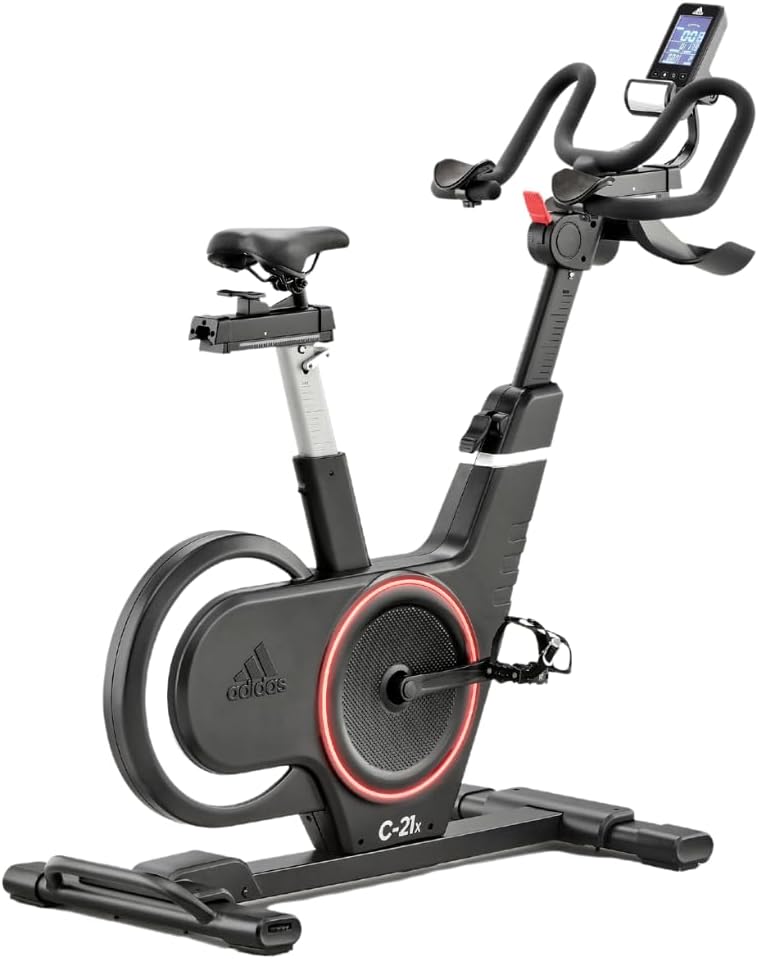
Adidas C-21X Indoor Spin Bike
Check the current listing price live price, May 2026
Stock checked the day this updated, re-verify on the listing before ordering.
Magnetic resistance with 16 levels. 18 kg flywheel. 165 mm Q-factor. Coated steel frame with sealed bearings. Dual-sided SPD and flat pedals. 150 kg user rating. Belt drivetrain, not chain.
Amazon.sg listing unavailable (checked 22 September 2026)Before clicking, tape out the bike's footprint on the floor (roughly 120 cm by 55 cm), measure the doorway it has to come through, and check that the floor under the rear stabiliser is level enough that the bike won't rock under load. Budget another S$60 for a 6 mm rubber mat to protect the tiles and damp the small amount of vibration that does reach the floor. The bike is heavier than couriers expect, so confirm the delivery option includes carry-up before you confirm the order. Then ride it.
If your honest usage is below ten rides a month, the right answer is still a studio credit pack or an ActiveSG membership, regardless of how well any home bike sidesteps the six mistakes. The list above isn't an argument for buying. It's an argument for buying right, conditional on the math already working in your favour.
Stock and price checked May 14, 2026. Worth re-checking before you order, listings shift week to week.
Affiliate disclosure: Gyms.sg earns a commission on purchases at no additional cost to you. Studio and local distributor recommendations are unaffiliated.
Related Guides
Picking a Home Elliptical in Singapore (2026): One Pick, Plus What to Skip
Compare elliptical stride, available floor space, ceiling clearance and servicing before deciding whether ownership fits your routine.
The 5 Mistakes That Wreck a Home Gym Build in a Singapore HDB
Most HDB home gyms get built twice. Here are the five mistakes that force the rebuild, and the single piece of

Best Spin Bikes for Home Singapore 2026
The honest take on home spin bikes for Singapore in 2026 , why Amazon SG imports fail, when Peloton SG makes s
Home Gym Barbell Set Singapore
Home gym barbell set guide for Singapore , Olympic vs standard, which set actually survives HDB humidity, and