
Yoga Mat Thickness Singapore (2026)
The standard Manduka PRO Lite is 1.3kg lighter than the PRO, despite only 1.3mm less thickness. Choose by carrying weight, practice surface and size before treating a thicker mat as an upgrade.
As an Amazon Associate, Gyms.sg earns from qualifying purchases. Links here, including to our partner brand OnWhey, may earn us a commission at no extra cost to you.
Choose a yoga mat by where you'll use it and how often you'll carry it. A 6mm Manduka PRO gives you a thicker home mat, a 4.7mm PRO Lite reduces the carrying weight, and a 2mm PRO Travel prioritises packing. Thickness alone doesn't tell you how a mat will feel.
You want to unroll a mat that suits the session without wishing you'd brought a different one. That might mean space for your hands during floor work, less weight on the way to class, or a packable surface over a studio mat.
The useful comparison is between complete products. A 6mm mat and a 4mm mat can differ in material, width, surface texture, and density as well as thickness. Start with the part of your current setup that you want to change.
Will the mat stay at home?
A mat that stays at home can prioritise its practice surface over carrying weight. The standard Manduka PRO specification lists 6mm thickness, 180cm length, 66cm width, and 3.4kg weight. Manduka describes the PVC construction as dense and firm.
The width is worth measuring on your floor. Mark out a rectangle before ordering, then check that furniture and open doors won't crowd it. A product photograph can't tell you whether your hands will meet the edge of a table when you move beyond the mat.
For this use, the PRO's weight is less of a purchasing disadvantage because it stays in one room. You still need somewhere to dry and store it. A mat that fits neatly under a bed while rolled can be awkward to leave flat after cleaning, so think about both arrangements.
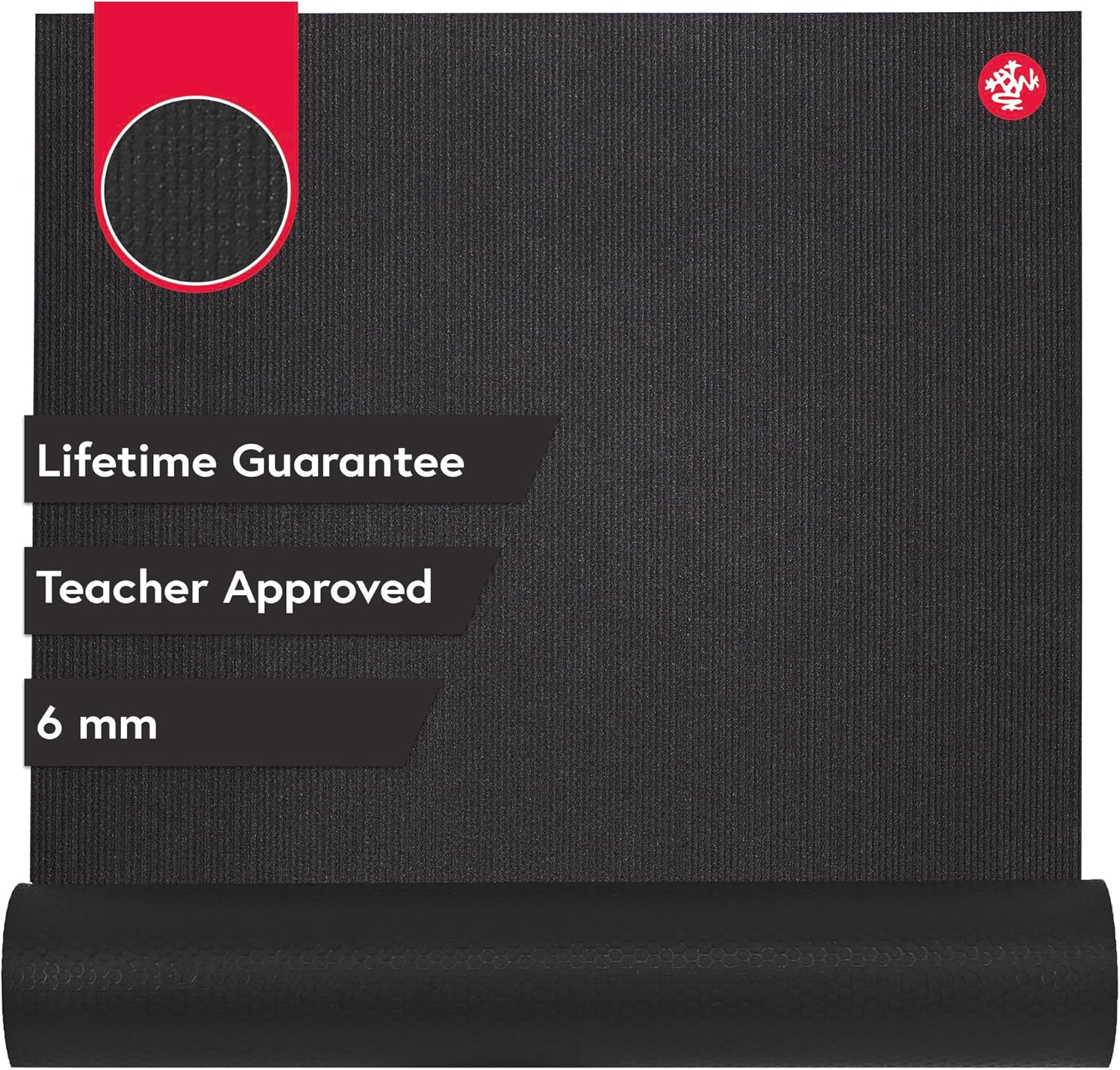
Check Manduka PRO Yoga Mat price on Amazon. Match the size and model, then check the seller's delivered total. The standard, short, and long versions shouldn't be treated as the same purchase.
Keep your existing mat if you already like its surface and only need somewhere else to put it. A better storage arrangement costs nothing if there is suitable space available. Extra thickness isn't a reason to replace something that is doing the job.
Will you carry the mat to class?
A mat for regular travel to class should be judged by its actual weight and rolled dimensions. The standard Manduka PRO Lite is 4.7mm thick and weighs 2.1kg, with a 180 × 61cm practice surface. It is 1.3kg lighter and 5cm narrower than the standard PRO.
Those differences give you a concrete choice. If the mat shares a bag with work items and a water bottle, compare the total load you will carry rather than the mat in isolation. If you drive and leave the mat in one studio, the weight may have less influence.
Don't assume “Lite” means a different type of foam. Manduka specifies PVC for both models. The published dimensions explain why the lighter mat takes less material; they don't prove that everyone will prefer its feel during practice.
I would pay more attention to the 1.3kg difference than the colour chart if the mat had to come with me every day. That's weight you carry before the session even starts.
If you're choosing classes at the same time, check the yoga studio directory and ask whether mats are supplied, whether you may use a personal mat, and where it can be stored. A studio that provides a suitable mat may remove the carrying problem entirely.
Is a travel mat a replacement for your usual mat?
A travel mat is most useful when packing size matters and you understand the surface it will sit on. The Manduka PRO Travel is 2mm thick, weighs 1.3kg in the standard size, and measures 180 × 61cm. Manduka describes it as foldable for travel and suitable for layering over a shared mat or carpet.
That makes it a different purchase from a thicker home mat. A surface that works over an existing studio mat may feel inadequate on a hard floor to someone who wants more cushioning. Think about the actual destination rather than buying the thinnest model because it fits in a suitcase.
Ask what is available where you're going. If a class provides mats, a packable layer may be the only item you need to bring. If it doesn't, compare whether you would rather carry your regular mat or arrange a mat at the destination.
Manduka's care instructions also distinguish packing from storage: the PRO Travel can fold for transport, but the brand says to store it rolled. “Foldable” isn't permission to leave it compressed indefinitely. Check that you have space to dry it and roll it again after use.
| Mat, standard size | Thickness (mm) | Weight (kg) | Length × width (cm) | Main reason to choose it |
|---|---|---|---|---|
| Manduka PRO | 6 | 3.4 | 180 × 66 | Thicker, wider mat that stays at home |
| Manduka PRO Lite | 4.7 | 2.1 | 180 × 61 | Lower carrying weight for regular classes |
| Manduka PRO Travel | 2 | 1.3 | 180 × 61 | Packable layer for travel |
These are manufacturer specifications for the standard versions, checked in September 2026. The product pages linked above are specification sources; they don't establish the price or delivery terms for a different retailer.
Will a thicker mat stop your hands slipping?
Extra thickness doesn't, by itself, resolve a slippery surface. The surface material and moisture need separate attention. Manduka's mat overview explains that its closed-cell PRO surfaces don't absorb moisture and can feel slippery with sweat; the brand recommends a suitable towel for that situation.
So if your main complaint is sliding hands, replacing a thin mat with a thicker version of the same surface may leave the complaint unchanged. Describe when it happens before choosing a replacement: from the first pose on a dry mat, only after sweating, or after a particular cleaner was used.
Read the care instructions for the model you already own. Don't assume that a household cleaning mixture or a treatment recommended for another material belongs on yours. Also allow time for the mat to dry as instructed instead of rolling it away immediately.
The Manduka PRO buying guide covers the home-mat decision in more detail. For a lower spending limit, the budget yoga mat guide is a useful comparison, provided you still match the surface to the problem you're trying to solve.
What matters besides the millimetres?
Check length, width, and care requirements before comparing the checkout total. Thickness is only one dimension, and a small difference in the headline measurement can distract from a much larger difference in how you use the mat.
Length deserves attention if your hands or feet regularly extend off your current mat. Measure that mat and compare it with the version being sold. A product family may include several lengths, and the photograph may show a size other than the one selected.
Width matters when you like more room across the surface, but make sure the space where you practise accommodates it. At a class, ask about the floor layout. At home, consider the room around the mat as well as the rectangle underneath you.
For sessions that mix yoga with other activities, check the manufacturer's intended use. Don't assume every yoga mat is made for shoes or contact with exercise equipment. If your routine is mainly mat Pilates, ask a Pilates studio what it uses for that class before buying a mat based on yoga specifications alone.
For a wider home setup, the home gym equipment guide helps you separate a practice mat from equipment that needs its own floor protection. Keep the purpose of each purchase clear.
What is the smaller next step?
Try a class with the mat provided before buying your first personal one. Check availability and any rental charge with the studio beforehand. Notice whether your concern is carrying weight, surface grip, or how the floor feels under the movements in that class.
If you're still deciding where to practise, use the gym and studio directory to find a session you can actually attend. A mat purchase can wait until you know the format you enjoy and the equipment already included.
For an existing mat, measure it and write down one change you want. “Lighter to carry than my current 3kg mat” is a useful shopping requirement. “A better mat” gives a seller much more room to persuade you without solving anything specific.
Frequently asked questions
Is 6mm always better than 4mm for yoga?
No. The material, density, size, and carrying weight also affect the choice. Compare complete mats and identify what you want to change about your current setup.
Is the Manduka PRO Lite the same size as the PRO?
No. The standard PRO Lite measures 180 × 61cm, while the standard PRO measures 180 × 66cm. Both brands and retailers can offer other size variants, so check the selected one.
Can I use a 2mm travel mat on its own?
That depends on the surface and the feel you prefer. Manduka describes the PRO Travel as an option for layering over carpet or a shared studio mat; don't assume it will feel like a 6mm mat on a hard floor.
Does thicker mean less slippery?
No. Grip is a separate surface question. For a mat that becomes slippery with sweat, follow the manufacturer's guidance for that material rather than choosing a replacement only by thickness.
Updated 22 September 2026: added thickness, size, and carrying-weight comparisons for the standard Manduka PRO, PRO Lite, and PRO Travel.